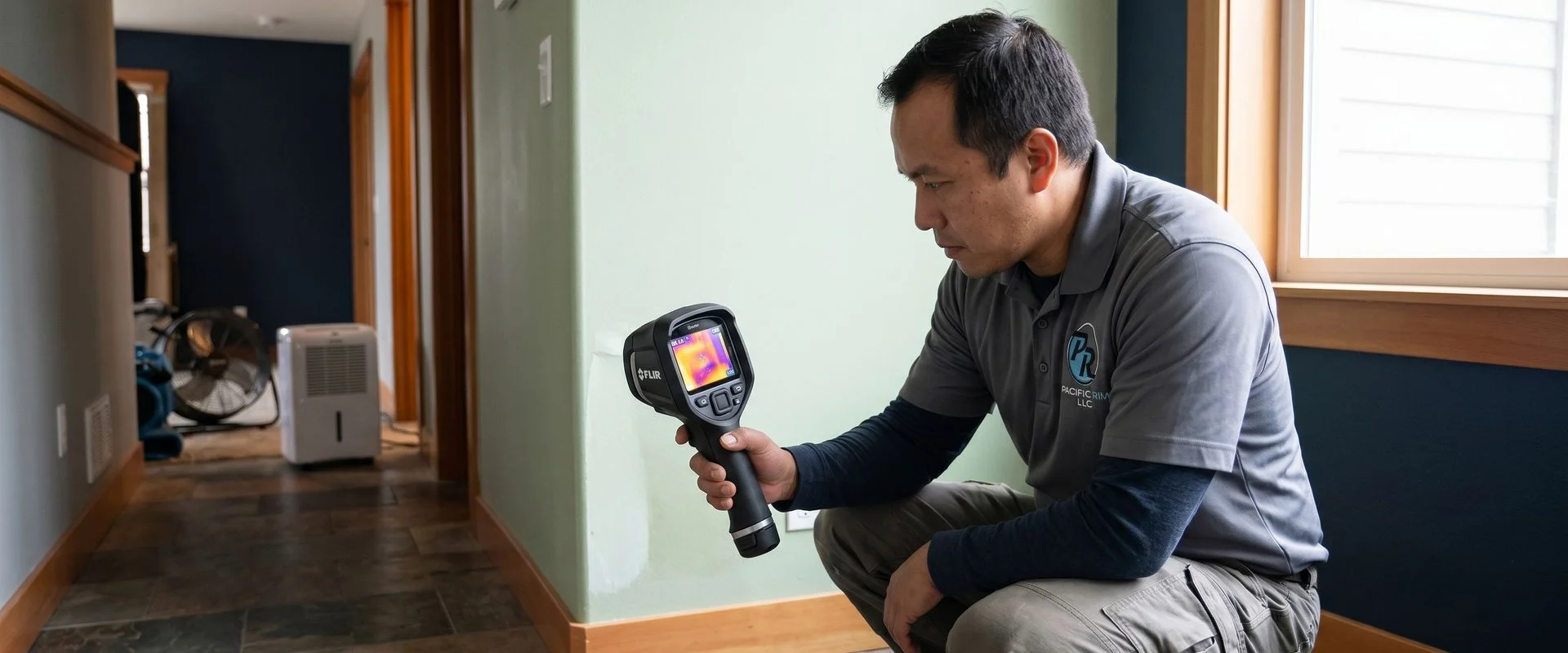
Certified Thermal Imaging Leak Detection in Seattle, WA
FLIR infrared and moisture-meter diagnostics that locate hidden leaks without destructive testing.
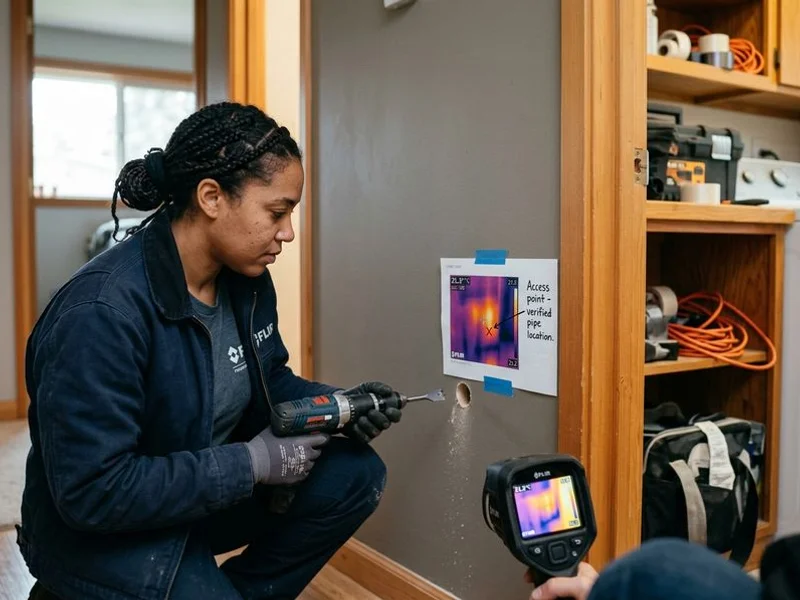
Not every water problem is visible. Our FLIR infrared cameras and digital moisture meters trace hidden water paths behind drywall, plaster, and concrete, pinpointing the source before any demolition begins. Non-invasive moisture mapping saves you the cost and disruption of tearing out walls to find it, and feeds directly into a targeted restoration plan.
What's included
Have you ever stared at a growing water stain on your living room ceiling and felt that immediate knot of panic?
We know how stressful a sudden property emergency can be. Seattle Water Damage Restoration provides professional water leak detection for residential and commercial properties across King County and Snohomish County. That unexplained spike in your water bill or sudden musty smell often signals a hidden disaster. The typical American homeowner spends about $15,400 on the average water damage claim, according to recent 2026 Insurance Information Institute data.
You certainly want to avoid becoming part of that statistic. The right knowledge makes all the difference.
Our team relies on a non-invasive diagnostic approach using two pieces of technology that work perfectly together. Smashing holes in your drywall just hoping to find the source is the old, expensive way.
Drywall repair alone can cost between $300 and $900 (2026 rates) before anyone even touches a pipe. This simple guide will show you exactly how thermal imaging leak detection works, step by step.
How FLIR Infrared Cameras Trace Hidden Water
We use thermal imaging because wet building materials naturally cool down through evaporation. This process makes the damp spots slightly colder than the completely dry surfaces right next to them.
Our professional-grade FLIR E8-Pro infrared cameras visualize that tiny temperature difference as a distinct, brightly colored thermal signature. These incredibly sensitive cameras can detect temperature variations as small as 0.05 degrees Celsius. You can literally see the shape of the water’s path tracing back to the hidden source. The same approach locates moisture trapped beneath flat roof membranes, inside slab-on-grade foundations, and behind tile shower surrounds - all spots where leaks travel far from their origin before showing any visible sign.
Finding the moisture quickly is critical because the Environmental Protection Agency notes that mold can begin growing on damp surfaces within just 24 to 48 hours. In the Pacific Northwest, where heavy rain and high humidity are year-round realities, hidden leaks accelerate faster than in drier climates. We step in fast to map the damage before that happens.
Infrared technology alone can sometimes produce false positives. Cold air blowing through gaps behind your walls or structural cold-bridging can look surprisingly similar to an active plumbing supply line leak or a failed pipe joint. Our standard procedure is to always verify those camera readings with a digital moisture meter.
The combination of these two diagnostic tools produces highly reliable, verifiable findings. We then provide you with a comprehensive written report detailing the exact situation. This official document includes:
- Annotated infrared photos that pinpoint the exact leak source
- Clear meter readings that confirm the active moisture content
- A recommended scope of work for the smallest, least invasive repair possible
You can hand this report straight to your plumber for a precise fix. This documentation is also exactly what your insurance adjuster needs to process your claim smoothly. Seattle Water Damage Restoration can then handle the water-damage cleanup as a separate scope of work when you are ready.
Here is a quick look at how thermal diagnostics save you time and money compared to the old-fashioned way:
| Feature | Traditional Method | Thermal Imaging Detection |
|---|---|---|
| Method | Cutting holes in drywall to find pipes | Non-invasive surface scanning |
| Diagnostic Cost | High (requires drywall patching, $300-$900+) | Low (no destructive repairs needed) |
| Time Required | Hours to days of demolition | Usually under 60 minutes |
| Clean Up | Dusty, messy, and disruptive | Zero mess left behind |
Professional Diagnostic Tools We Use
We bring IICRC-standard diagnostic technology into your home or commercial facility to ensure accurate results. This specialized gear allows us to find the water fast without making a mess. Every second counts when dealing with water damage.
The complete toolkit features the following industry-leading devices. Each tool serves a specific purpose in the diagnostic process:
- FLIR thermal imaging cameras (current professional-grade models, like the FLIR E8-Pro, capable of sensing microscopic temperature shifts)
- Pin-style and pinless digital moisture meters (featuring the dual-function Protimeter Surveymaster, which can scan up to 3/4 of an inch behind a wall without leaving a single mark)
- Borescope cameras for behind-wall confirmation when warranted
- Hygrometers for ambient humidity context (essential for understanding the overall drying environment)
- Annotated reporting with photo overlays
Seattle Water Damage Restoration technicians calibrate all of this equipment daily to guarantee pinpoint accuracy. Precision preparation means you get answers you can rely on immediately. If you suspect a hidden water issue in Queen Anne, Ballard, Redmond, or anywhere in the Greater Seattle area, do not wait for the damage to spread. Reach out today to schedule your thermal imaging leak detection, and let our IICRC-certified team protect your property.
Our Leak Detection Process
Interview & inspect
We talk through symptoms (stains, smells, bills) and inspect visible affected areas to narrow the search.
Thermal scan
FLIR infrared cameras scan walls, ceilings, and floors. Cooler areas (evaporative cooling from moisture) show as distinct thermal signatures.
Meter verification
Digital moisture meters verify the thermal findings - pin-style or non-invasive sensors confirm actual moisture content.
Report & plan
You get a written report with annotated photos pinpointing the leak source and recommending the smallest possible repair scope.
Why Seattle Water Damage Restoration for Leak Detection?
Save your walls
Non-invasive diagnostic spares you from tearing out drywall to 'go looking.' Targeted repair, not exploratory demolition.
Two-tool verification
Thermal imaging finds candidates; moisture meters confirm. No false positives from cold air gaps or radiator shadows.
Documented for insurance
Annotated infrared images and meter readings make a strong case with adjusters, especially for hidden gradual leaks at the edges of coverage.
Restoration-ready findings
Our leak detection feeds directly into your restoration plan with us or with your preferred plumber for source repair.
Ready to stop the damage?
Direct insurance billing. Most clients pay $0 out of pocket. A certified tech on-site in 60 minutes.
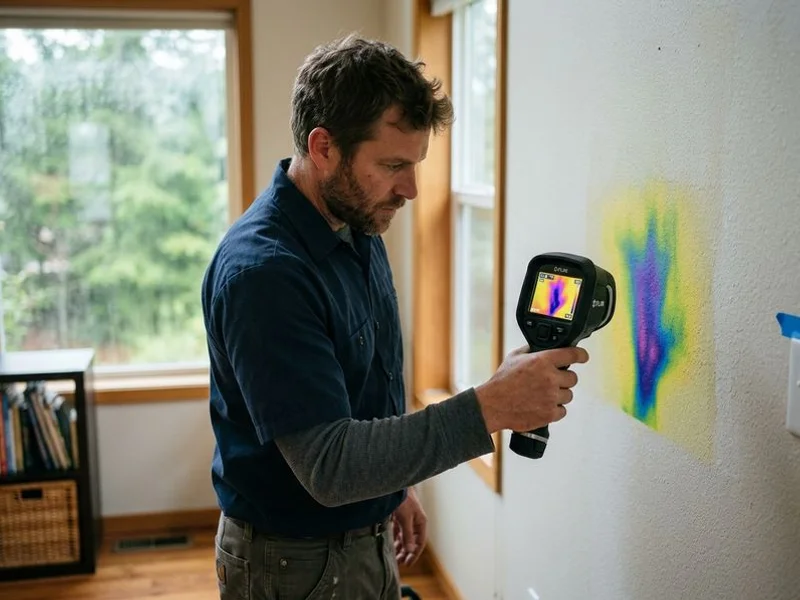
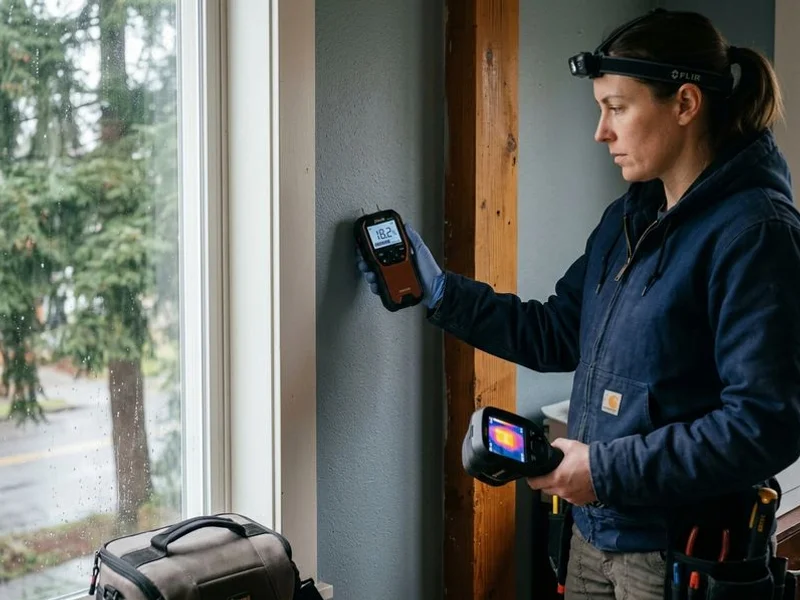
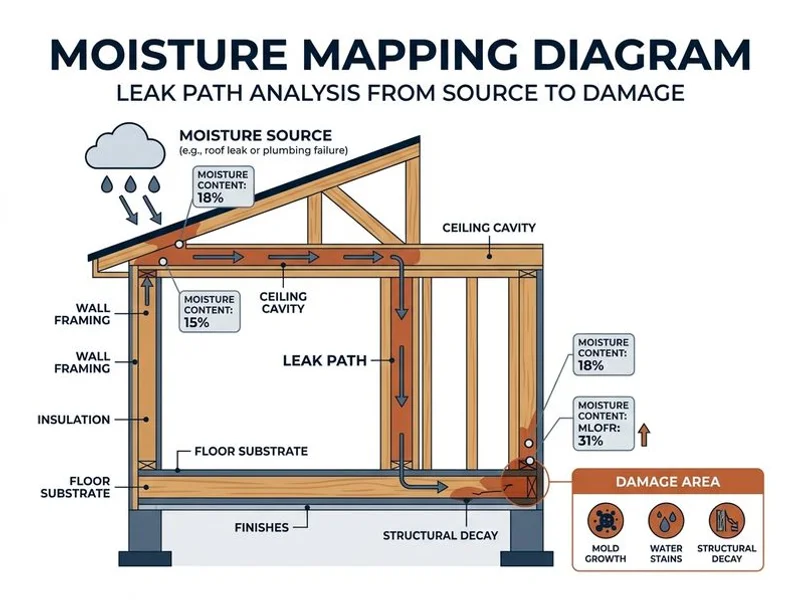
Leak Detection in action
What customers say about our Leak Detection
"We had a water stain on the ceiling that kept coming back. They scanned with thermal and found the leak was actually three feet over from the stain - a small fitting in the wall. Saved us from a giant exploratory hole."
Megan A.
Capitol Hill, Seattle
"Insurance kept denying the claim because the source wasn't documented. They scanned, mapped it, and wrote a report that got it covered."
Daniel F.
Bellevue
"Quick, clean, and the report was incredibly clear. Took our plumber straight to the source - no guessing."
Rita N.
Mukilteo
Leak Detection questions
How does thermal imaging detect water?
Is thermal imaging always accurate?
When would I need this service?
Do you fix the leak too?
How long does an inspection take?
How much does a thermal imaging inspection cost?
Will insurance cover this?
Leak Detection guides
How Infrared Cameras Find Water Leaks
Thermal imaging shows hidden water leaks through temperature differences. How it works and what it can and can't see.
Signs of a Hidden Leak in Your Wall
Stains, smells, peeling paint, bubbling drywall — recognize hidden wall leaks before they become major damage.
Non-Invasive Leak Detection vs. Exploratory Tear-Out
Thermal imaging vs. opening walls to find leaks. Why non-invasive almost always wins.
Related services
Emergency Water Removal & Extraction
24/7 emergency water removal and structural drying for flooded basements, burst pipes, and storm intrusion.
Mold Remediation
Comprehensive mold inspection, containment, removal, and clearance testing to IICRC S520 standards.
Crawl Space Cleanup & Encapsulation
Standing-water extraction, joist sanitation, vapor barriers, and full crawl space encapsulation.
Ready for leak detection?
A certified technician can be on your doorstep in 60 minutes. Direct insurance billing, most clients pay $0 out of pocket.
Last updated: June 19, 2026