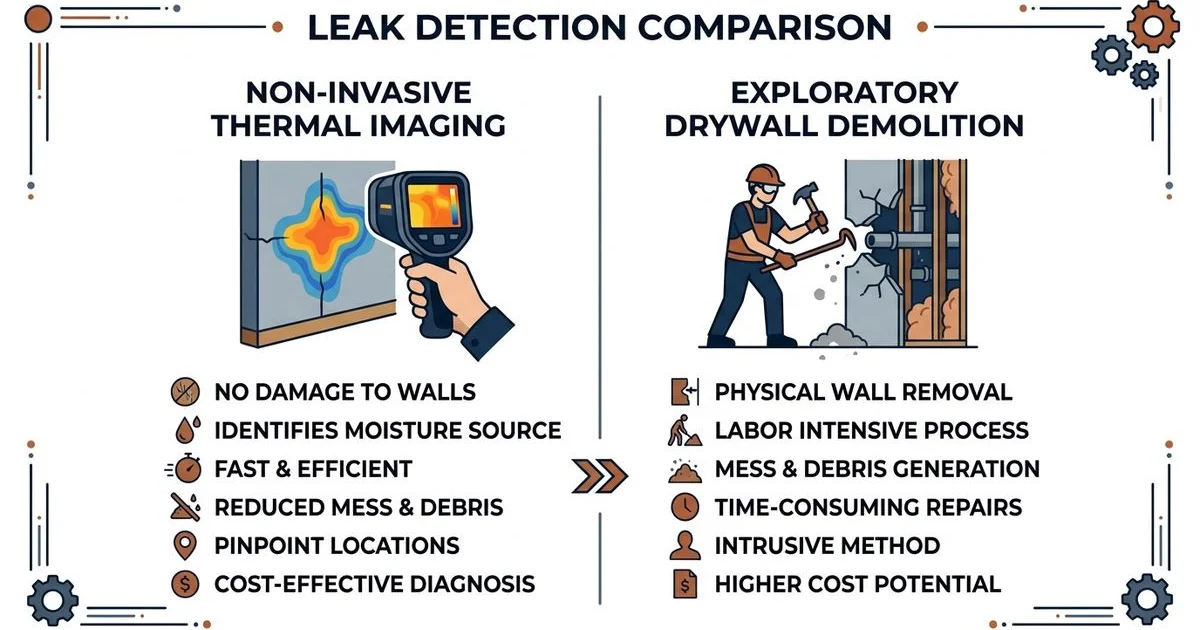
Two approaches to the same problem
From what the experts see every week, that mysterious wall stain is usually a sign of a much larger issue hiding just out of sight. We know the immediate reaction is panic. But grabbing a sledgehammer is the worst thing you can do.
Let’s look at the data, what it is actually telling us, and explore the practical ways to respond. The EPA estimates that 10 percent of US homes have active leaks wasting 90 gallons or more every single day. The question is how to find the source quickly.
You have two basic approaches to the problem.
- Tear-out: Open the wall, floor, or ceiling where you think the leak is. Look at what you find. If you find the source, great. If not, open another section and try again.
- Non-invasive detection: Use thermal imaging and moisture meters to identify the source through the wall surface. Open only the small section needed to make the repair.
Here is why the non invasive leak detection vs tear out debate almost always has one clear winner.
Cost comparison
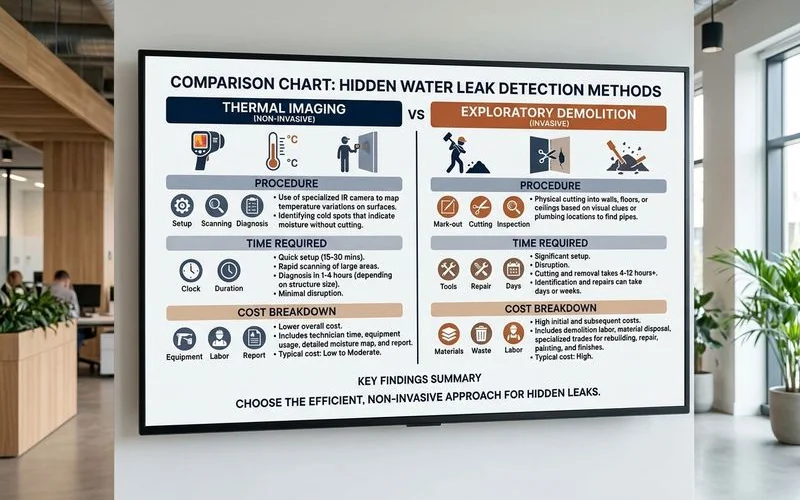
A typical exploratory demolition easily pushes your total bill past the 2026 US average of $3,800 to $5,500 for water damage restoration. We see homeowners double their expenses simply by guessing wrong. Here is a breakdown for a typical hidden leak situation.
| Expense Category | Exploratory Tear-Out | Non-Invasive Detection |
|---|---|---|
| Initial Discovery | $200-$500 per section (2-4 typical) | $400-$800 professional inspection |
| Accuracy Penalty | Cost of guessing wrong and reopening | Single pinpointed location |
| Wall Reconstruction | $500-$1,500 per opened section | $300-$800 single repair |
| Mold Remediation | $2,000+ if hidden mold is found | Targeted during repair |
| Paint and Finish | $500-$2,000 to match multiple areas | Repaint local area only |
| Total Estimated Cost | $3,000-$10,000+ | $1,500-$3,500 |
The cost difference is significant. A professional inspection using tools like the FLIR MR176 almost always finds the source on the first try. This precision saves you from paying for unnecessary drywall reconstruction.
Time comparison
Using targeted detection cuts your repair timeline in half compared to a messy exploratory demolition. We recommend acting fast because mold can begin growing on wet drywall within just 24 to 48 hours. The drying phase is where the biggest delays happen.
| Project Phase | Exploratory Tear-Out | Non-Invasive Detection |
|---|---|---|
| Discovery & Demolition | 1-2 days | 1-3 hours (report in 1-2 days) |
| Source Repair | 1 day | 1 day |
| Drying Time | 3-7 days (standard fans) | 24-72 hours (professional air movers) |
| Reconstruction | 3-5 days | 1-2 days (small area) |
| Paint and Finish | 2-3 days | 1 day |
| Total Timeline | 2-3 weeks | 1-2 weeks |
Less disruption means a faster resolution. You avoid turning your living room into a construction zone for nearly a month.
Accuracy comparison
The thermal imaging vs demolition debate comes down to precision. The biggest risk with tear-out is missing the actual source entirely. Water travels. It can show up as a stain 8 feet away from where it is actually entering your home.
Open the wall directly below the stain, and you may find dry framing. The leak is elsewhere.
Thermal imaging traces the exact path of the moisture instead of relying on guesswork. Advanced tools like the FLIR ONE Pro thermal camera read temperature differences caused by water evaporation to guarantee precision. This technology maps the invisible moisture footprint behind your walls through a few specific markers:
- Temperature drops: The camera highlights cool zones where water is actively evaporating.
- Flow patterns: Moisture often takes a recognizable shape as it flows from the source to the drainage point.
- Material anomalies: A trained technician spots low emissivity variances on highly reflective metallic plumbing fixtures to avoid false readings.
Our professional leak detection reports include annotated thermal images showing this exact path. Then the targeted repair addresses the actual source rather than relying on a guess.
When tear-out is acceptable
Tear-out is acceptable only when the damage is so severe that the entire wall requires replacement anyway. Our technicians at Seattle Water Damage Restoration will tell you that the non-invasive approach is not always required. Recent 2026 insurance data shows the average US water damage claim exceeds $11,000. When damage hits that level, extensive removal is inevitable. Tear-out is fine when:
- The drywall section is already being replaced for other reasons like severe water damage or mold remediation.
- The source location is obvious and unambiguous.
- Inspection access from the other side is impossible.
- You have already done the thermal scan and just need access to make the repair.
In these cases, tear-out is not exploratory. It is the planned access for a known source.
Why not just guess?
Guessing often doubles your repair costs and leaves hidden moisture behind to feed mold. For motivated DIY homeowners, opening one section and looking is a common temptation. The math simply does not favor it.
- 30-50% probability of opening in the right spot on the first try.
- 50-70% probability of needing to open more sections.
- Each section opened adds to the eventual rebuild cost.
- Missing the source leads to repeated water damage in the same area.
You need to find a leak without tearing the wall apart just to be sure. Professional inspections use digital moisture meters to verify wet spots.
A reading above 12 percent moisture content confirms the thermal findings instantly. For the cost of a professional inspection, you get a much higher first-attempt success rate and a documented record for your insurance provider.
What’s actually involved in the inspection
A professional inspection maps the moisture footprint without moving a single piece of furniture. Our process is completely non-disruptive. Walls do not get damaged. Most homeowners barely notice that the inspection happened.
For most US home inspections, the process includes:
- Initial discussion (15-30 minutes): symptoms, history, suspected areas.
- Thermal scan (45-90 minutes): all suspected and adjacent areas.
- Moisture meter verification (15-30 minutes): confirming thermal findings.
- On-site discussion: reviewing the immediate findings together.
- Written report (1-2 business days later): annotated photos, source identification, repair recommendations.
This comprehensive documentation is vital. Presenting a detailed thermal scan report makes filing a claim much smoother for your insurance adjuster.
What to do this week
If you have signs of a hidden leak, schedule an inspection before swinging a hammer. The cost-benefit math of the non invasive leak detection vs tear out decision is overwhelming.
The exception is if you have an active emergency requiring immediate access, like a burst pipe pouring water. In that case, shut off the main supply and call for an emergency response.
For the typical hidden leak situation, professional inspection is the right first step. Protect your home and your wallet by letting the data guide your repairs. Contact our team today to schedule your comprehensive thermal imaging assessment.
Frequently Asked Questions
Why would anyone choose tear-out over thermal imaging?
Can thermal imaging always find the leak?
What if the inspection doesn't find a leak?
Related Guides
How Infrared Cameras Find Water Leaks
Thermal imaging shows hidden water leaks through temperature differences. How it works and what it can and can't see.
Signs of a Hidden Leak in Your Wall
Stains, smells, peeling paint, bubbling drywall — recognize hidden wall leaks before they become major damage.
Learn more about Thermal Imaging Leak Detection
Talk to a real local dispatcher 24/7. Certified technicians on-site in 60 minutes — direct insurance billing.