Watching water spread across your living room floor is incredibly stressful.
We know exactly how fast a flooded basement can upend your daily routine. This sudden chaos forces you to make major decisions quickly.
Our crew at Seattle Water Damage Restoration handles these specific emergencies every single day. A rapid response prevents minor issues from becoming massive financial burdens.
We will outline the exact emergency restoration steps from the initial phone call to the final structural repairs. Knowing what to expect during water extraction gives you the clarity needed to protect your home.
The first call
Calling the local dispatch team is the first step to quickly confirm your emergency details. We confirm the nature of your leak and dispatch technicians immediately.
Real people answer the phone in the US, not a distant call center menu. Our primary goal is to arrive on-site within 60 to 90 minutes. National data shows that average emergency response times matter greatly because water spreads rapidly.
We will guide you over the phone to find your main water shutoff valve. You will usually find this valve near the water meter or in the basement. Our team recommends turning the handle perpendicular to the pipe to stop the flow.
Critical steps to take while the truck is en route:
- Identify the main water shutoff valve.
- Turn off electricity to the affected rooms if it is safe.
- Move small, valuable items to a dry area.
- Keep pets and children away from the standing water.
Arrival
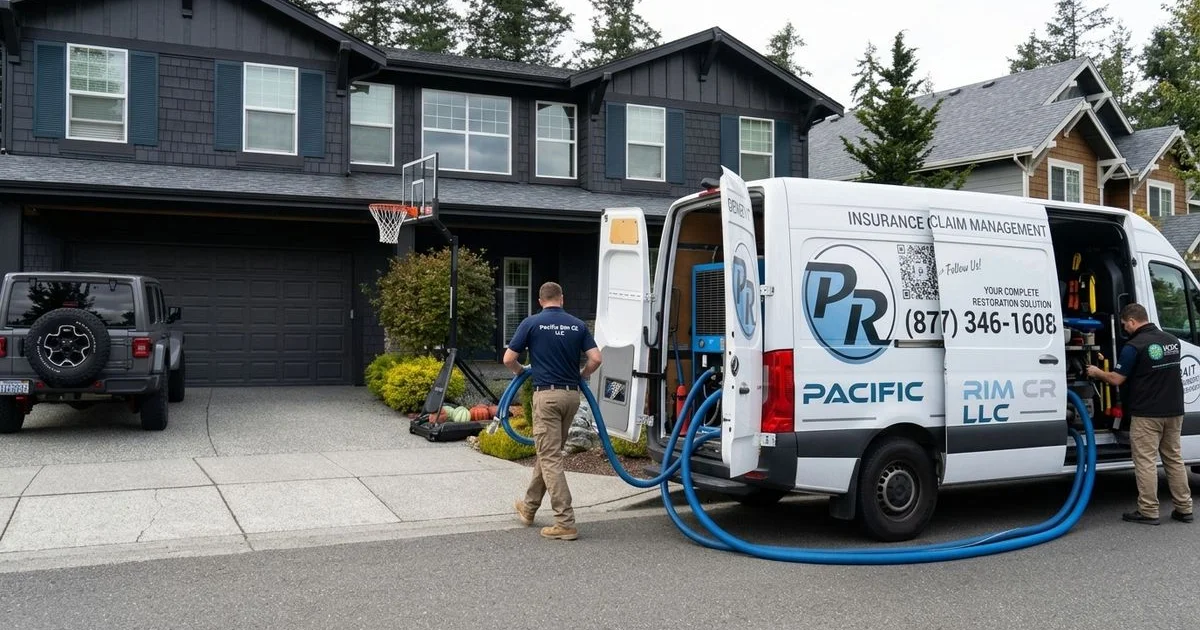
A marked truck arrives with specialized extraction tools and safety gear. We start by identifying the source of the leak and ensuring the property is secure.
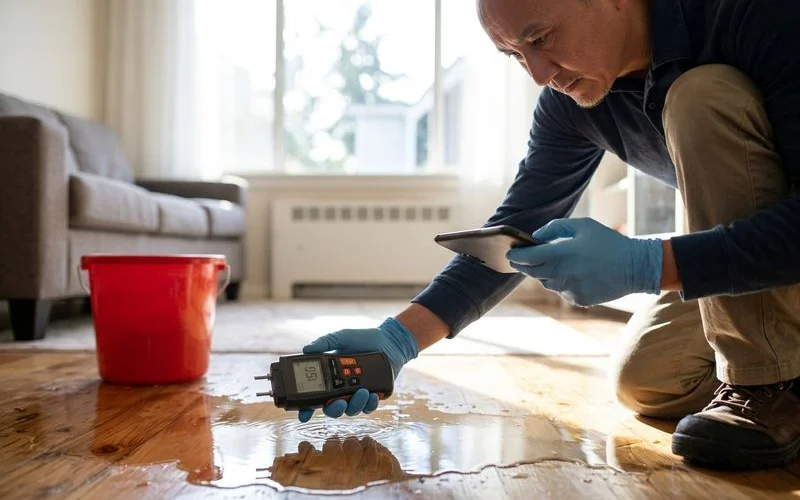
The lead technician takes baseline moisture readings using professional-grade tools like a Protimeter MMS3. Our initial assessment determines the classification of your damage based on Institute of Inspection, Cleaning and Restoration Certification (IICRC) S500 guidelines.
Categorizing the water correctly dictates the entire cleanup strategy. We classify the situation into one of three specific risk levels.
| Water Category | Source Example | Risk Level |
|---|---|---|
| Category 1 | Broken supply line | Clean, minimal health risk |
| Category 2 | Washing machine overflow | Significant contamination risk |
| Category 3 | Sewage backup or floodwater | Grossly contaminated, severe hazard |
Stopping an active flow is the immediate priority if a pipe is still running. We confirm the water is off before setting up the heavy equipment.
Documentation
Taking clear photographic evidence protects your financial interests. We document the pre-mitigation condition of your property to show carriers exactly what happened. Recent data from the Insurance Information Institute indicates the average US water damage claim costs roughly $15,400.
Our emergency water removal team uses industry-standard platforms like Xactimate to build a precise, line-item estimate. This software separates the emergency drying costs from the rebuilding expenses.
We know that insurance adjusters require this strict level of detail for approvals. A clean estimate prevents unnecessary delays and out-of-pocket surprises.
Using standardized estimating software like Xactimate is the most effective way to ensure your carrier approves the necessary drying expenses.
Extraction
Truck-mounted vacuums pull standing water out of your floors to stop further saturation. We use high-volume hoses to remove moisture from the surface and deep within carpet pads.
The Environmental Protection Agency notes that mold can begin growing within 24 to 48 hours. Our fast water extraction process is the best defense against this secondary damage.
The Speed of Surface Extraction
Surface extraction works quickly on hard materials like tile or sealed concrete. We typically spend two to six hours pumping water out of flooded basements depending on the depth.
You will hear a loud machine running outside during this phase. Our crew works methodically through every single affected room inside the house.
Material decisions
The crew evaluates wet drywall, insulation, and framing to determine what is salvageable. We consult the IICRC S500 standards to make objective, data-driven choices about your home.
The crew almost always discards carpet padding saturated with Category 2 or 3 water. Our default approach for older homes with original hardwood is to dry the material in place whenever possible.
Technicians cut contaminated drywall at least four inches above the highest water mark. We explain the reasoning behind every cut before bringing out the saws. Wet insulation packed inside wall cavities must come out to allow proper airflow.
Replacing a wet carpet pad is a minor expense compared to the cost of treating severe mold growth caused by trapped moisture.
Drying setup
Industrial air movers and commercial dehumidifiers run continuously for three to five days. We use Low Grain Refrigerant (LGR) dehumidifiers rather than standard consumer units. A hardware store model might pull two pints of water a day.
Our commercial LGR units extract up to 130 pints daily to aggressively dry the structure. Heavy plastic containment barriers isolate the wet zones to maximize equipment efficiency. We try to keep the noise and disruption to unaffected rooms as minimal as possible.
The fans create a constant hum similar to a window air conditioner. Our technicians place these machines strategically to create a specific airflow pattern.
The drying setup typically includes:
- High-velocity axial air movers.
- Commercial LGR dehumidifiers.
- Plastic containment sheets.
- Air filtration devices for contaminated losses.
Daily monitoring
A technician returns every single day to measure the moisture content of your walls. We track the drying progress on digital logs to prove the structure is safe.
Wood framing usually needs to reach an 8% to 12% moisture content level to meet the standard. Our equipment stays in place until every reading confirms the area is fully dry.
Hitting the Dry Standard
Consistent monitoring prevents premature equipment removal. We adjust the angle of the fans as different materials reach their dry goals.
The drying phase is officially complete once all materials meet the IICRC S500 dry standard. Our team tears down the plastic containment and loads the fans back into the truck.
Insurance coordination
In-house advocates speak directly with your insurance carrier to align the project scope. We submit the detailed Xactimate reports so you do not have to argue with an adjuster. Most US homeowners simply pay their standard policy deductible, which often averages around $1,000.
Our administrative team bills the rest of the approved mitigation directly to the insurance company. This direct billing system removes a massive layer of stress from your shoulders. We answer the technical questions the carrier asks regarding equipment usage and labor hours.
Clear communication with the adjuster keeps the claim moving forward smoothly. Our experience with local and national carriers speeds up the approval process.
Coordination tasks handled for you:
- Submitting the daily moisture logs.
- Providing the pre-mitigation photos.
- Detailing the equipment usage hours.
- Justifying the material removal choices.
Reconstruction
A dedicated project manager takes over to repair the drywall and install new flooring. We handle the transition from emergency drying to final restoration smoothly.
Rebuilding a standard residential room in the US typically takes between one and four weeks. Our team maintains the exact same communication style and documentation standards during this final phase.
Managing Timelines and Permits
Major structural changes or plumbing repairs often require local city permits. We coordinate these municipal inspections to keep the project moving legally and safely.
Material availability can occasionally influence the rebuilding schedule. Our project manager keeps you updated weekly on the status of your cabinets and flooring.
What you’ll experience
The initial panic fades quickly once the trucks arrive and the professionals take control. We manage the heavy lifting, the technical drying plans, and the frustrating insurance paperwork.
Nearly 1 in 60 insured homes files a water-related claim every year, meaning this process is highly standardized. Our goal is to make a disruptive event feel manageable and predictable.
The Final Walkthrough
You simply provide access to the property and approve the major material decisions. We communicate any unexpected discoveries, like hidden damage behind a wall, before taking action.
Most projects finish without any major surprises. Our crews leave your home clean, dry, and fully restored to its pre-loss condition.
Recovering from a flood is a structured process that requires speed and expertise. We are ready to answer your call and get your home back to normal. Knowing exactly what to expect during water extraction makes the recovery much smoother. Our emergency dispatch line is open today for immediate professional assistance.
Frequently Asked Questions
How long until the crew arrives?
Do I need to be home during extraction?
What does the equipment look like and sound like?
Related Guides
Burst and Frozen Pipe Water Damage: What to Do
Burst pipe or frozen pipe leak? Safe shutoff, cleanup, and what's covered by insurance — for Seattle homeowners.
Flooded Basement Cleanup: Steps and Timeline
Flooded basement? Safe steps, the cleanup process, and what affects how long it takes — for Seattle homeowners.
How Fast Do You Need to Extract Water to Prevent Mold?
Mold can grow in 24-48 hours after water damage. Here's the science behind the timeline and why fast extraction matters.
Psychrometric Structural Drying Explained
The science of professional structural drying — temperature, humidity, vapor pressure — and why it matters for water damage restoration.
Learn more about Emergency Water Removal & Extraction
Talk to a real local dispatcher 24/7. Certified technicians on-site in 60 minutes — direct insurance billing.