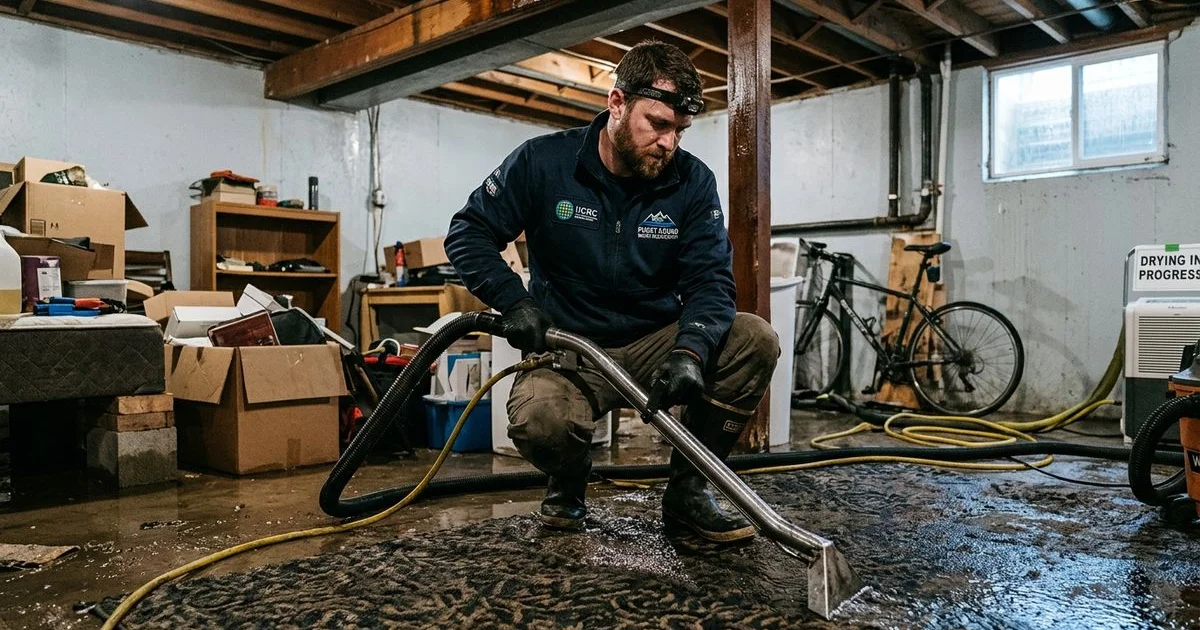
When water fills a basement, time is the enemy
Our team at Seattle Water Damage Restoration sees the immediate panic a flooded basement cleanup causes for homeowners. The saturated clay soil and heavy rainfall across King County create a high risk for property damage.
Older neighborhoods face aging sewer laterals that fail without warning.
We handle these emergencies by strictly following the Institute of Inspection, Cleaning and Restoration Certification (IICRC) standards. A minor plumbing leak quickly escalates into a major disaster if left alone.
Treating the root cause correctly is the only way to protect your investment.
Let’s look at the data behind the basement flood cleanup seattle homeowners frequently need, what the actual risks are, and the exact step-by-step process used to save a property.
Step 1: assess safety
Before anyone steps into the water, the power to the affected area must be completely shut off at the main breaker panel. Standing water near outlets, switches, or HVAC equipment carries a lethal electrical current.
Our technicians confirm the site is safe before proceeding with any inspection. The first physical task is identifying the active source and stopping the flow immediately. Shutting the main water valve or securing a sewer cleanout cap stops the damage from compounding.
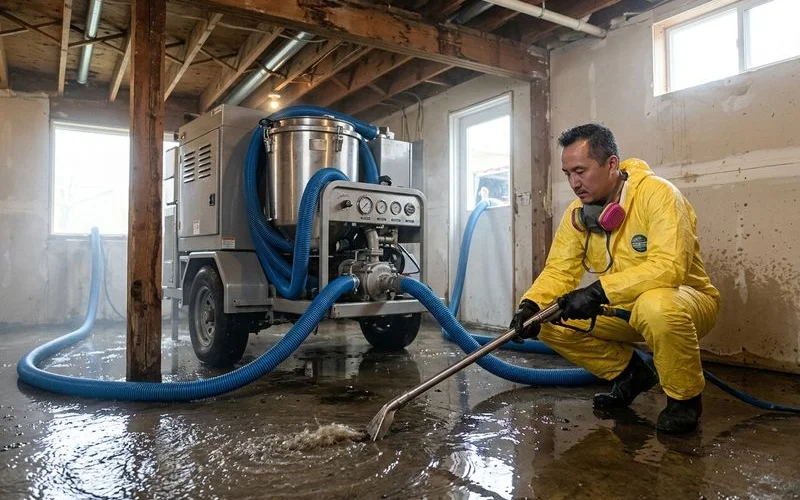
Sewage contamination drastically changes the safety protocol. The IICRC S500 standard classifies sewage backups as Category 3 water, meaning it contains harmful pathogens and requires full personal protective equipment (PPE). You cannot safely wade into a Category 3 flood without a hazmat suit and respirator.
Step 2: extraction
Fast basement water extraction requires industrial equipment that pulls standing moisture through high-volume hoses. The depth of the water and the presence of obstacles determine the exact timeline.
Our truck-mounted extraction systems handle the heavy lifting to prevent the structural framing from absorbing additional moisture. A standard 600 to 1,000 square foot space with a few inches of standing water usually takes two to six hours to pump out. Furniture, storage boxes, and other obstructions slow down the hose routing.
Here is how the extraction phase breaks down:
- Vacuum Lift: Truck-mounted units create up to 250 PSI of lift.
- Pumping Volume: Industrial submersible pumps move between 100 and 500 gallons per minute (GPM).
- Material Removal: Porous items soaked by Category 2 or 3 water are bagged and discarded immediately.
We move the salvageable items quickly and carefully document everything ruined for your insurance claim. Leaving contaminated items inside the property compromises the entire job.
Step 3: assessment and removal
Once the standing water is gone, the salvage operation begins. Hard-surface flooring like sealed concrete, ceramic tile, and sealed hardwood usually survives a clean water event.
Our specialists test the structural materials using advanced moisture meters to map the exact spread of the dampness. Carpet and the underlying pad rarely survive the saturation process. Even clean Category 1 carpet typically faces disposal once it becomes completely waterlogged.
Contamination levels dictate the demolition requirements. The IICRC standard mandates that any drywall touched by Category 2 or 3 water gets cut out at least four inches above the visible high-water line. Wall cavity insulation loses its thermal properties when wet and almost always requires complete removal.
Here is a quick reference for material survival rates after a flood:
- Sealed Concrete: Highly salvageable with proper sanitation.
- Ceramic Tile: Usually salvageable, depending on grout condition.
- Drywall (Category 1): Potentially salvageable if dried within 24 hours.
- Drywall (Category 2 or 3): Requires immediate removal and replacement.
- Carpet Pad: Discarded in nearly all water damage scenarios.
Thorough documentation continues throughout this step. Taking clear photos, recording moisture readings, and building an itemized inventory of removed materials makes the insurance claim process smoother.
Step 4: structural drying
Industrial-grade air movers and LGR (Low Grain Refrigerant) dehumidifiers run continuously for three to five days to dry the space. These machines are monitored daily to track the evaporation progress.
Our teams rely on the IICRC S500 standard to establish a dry goal based on the normal equilibrium moisture content (EMC) of undamaged wood. Surface dryness is a misleading metric for homeowners to use. The hidden moisture trapped deep inside the wall studs and floor joists causes long-term structural rot.
Subterranean spaces present unique drying challenges because they lack natural ventilation to the outside. Evaporated moisture has nowhere to escape naturally. The commercial dehumidifiers must capture the airborne water vapor and pump it directly into a drain.
Equipment Sizing Matters
Placing random fans in a wet room will not prevent structural damage. Calculating the exact cubic footage of the space dictates how many air movers are required to force evaporation. An undersized dehumidification setup allows the humidity to linger, which drastically increases the risk of secondary mold growth.
Step 5: sanitation and antimicrobial
Treating the exposed surfaces with EPA-registered antimicrobials prevents dangerous secondary mold growth. This step is mandatory for any loss involving contaminated Category 2 or 3 water.
Our technicians apply these professional-grade biocides to eliminate bacteria left behind after the physical debris is gone. The application is not a cosmetic deodorizer meant to cover up foul smells. It actively neutralizes microbial threats inside the remaining structural framing.
Clean water events also benefit from preventative sanitation. Damp wood or drywall that takes longer than 24 hours to dry receives a thorough antimicrobial treatment as a precaution. Black mold spores can germinate within 48 hours under the right humid conditions.
Step 6: reconstruction
The rebuild phase begins immediately after the space reaches the certified dry standard. This final stage involves replacing the cut drywall, painting, installing new flooring, and finishing the trim work.
Our emergency water removal team transitions directly to the reconstruction phase with the exact same project manager. Keeping the entire project under one roof eliminates miscommunication between contractors. You avoid the stress of scope renegotiation and frustrating scheduling delays.
Most standard basement rebuilds take one to three weeks to complete. The finish level of the room and the availability of specific custom materials dictate the final timeline.
What affects timeline
Two identical basement layouts can experience vastly different cleanup timelines based on several distinct factors. The contamination level and the physical materials present change the required strategy entirely.
Here are the primary variables that extend or shorten the process:
- Depth of standing water: A puddle dries significantly faster than three feet of flooding.
- Building materials: Unfinished concrete floors release moisture faster than carpet installed over a wooden subfloor.
- Source contamination: A toxic sewer backup adds one to two full days just for the mandatory sanitation and demolition steps.
- Ambient humidity: Seattle’s wet winter and atmospheric river season slow down the natural evaporation rate.
- Electrical power access: Running industrial generators due to a neighborhood power outage adds heavy setup time and logistical hurdles.
A typical burst pipe resulting in two inches of clean water takes about five to seven days to hit the target dry standard. A complex sewage backup spanning multiple finished rooms easily runs ten to fourteen days for mitigation alone, followed by a lengthy reconstruction phase.
Cost expectation
The total project cost varies wildly depending on the severity of the flood, but national 2026 data shows standard mitigation runs between $3 and $7.50 per square foot. Most insured clients pay only their policy deductible out of pocket.
Our billing department sends the mitigation invoices directly to your insurance carrier to minimize your upfront burden. The reconstruction work falls under the exact same approved scope.
| Damage Tier | Water Source Example | Average Cost Range (2026) |
|---|---|---|
| Category 1 (Clean) | Burst supply line, rainwater | $1,500 - $3,500 |
| Category 2 (Gray) | Washing machine overflow | $3,000 - $7,000 |
| Category 3 (Black) | Sewer backup, floodwaters | $7,000 - $15,000+ |
Severe black water events requiring extensive demolition push the total well past the standard averages.
Why Speed Reduces Cost
The single biggest factor in your final out-of-pocket expense is how fast the professional extraction begins. Stagnant water left overnight destroys more drywall, ruins baseboards, and dramatically increases the mold remediation costs.
Category 1 clean water naturally degrades into Category 2 gray water if left standing for 48 hours. This biological shift forces the demolition of materials that could have been saved on day one.
Our 60-minute rapid response guarantee prevents a manageable cleanup from spiraling into a catastrophic financial loss. Call a certified professional immediately to start your flooded basement cleanup and protect your home.
Frequently Asked Questions
Is it safe to enter a flooded basement?
How long does basement cleanup take?
Will my insurance cover basement flooding?
Related Guides
Burst and Frozen Pipe Water Damage: What to Do
Burst pipe or frozen pipe leak? Safe shutoff, cleanup, and what's covered by insurance — for Seattle homeowners.
How Fast Do You Need to Extract Water to Prevent Mold?
Mold can grow in 24-48 hours after water damage. Here's the science behind the timeline and why fast extraction matters.
Psychrometric Structural Drying Explained
The science of professional structural drying — temperature, humidity, vapor pressure — and why it matters for water damage restoration.
Can You Save Wet Hardwood Floors?
Wet hardwood floors don't have to be a total loss. Injectidry drying can save many wood floors — here's how it works and when it's worth trying.
Learn more about Emergency Water Removal & Extraction
Talk to a real local dispatcher 24/7. Certified technicians on-site in 60 minutes — direct insurance billing.