Our team regularly witnesses how a small water leak can quickly escalate into a massive property headache.
From what 2026 data shows, around 14,000 people in the US experience a water damage emergency every single day. This staggering number makes understanding psychrometric structural drying essential for protecting your home.
We will break down the science of moisture removal and explore exactly how this process works.
Why “just dry it out” isn’t a strategy
Tossing a fan into a flooded room is never a complete solution. Our approach relies on strict scientific principles to prevent costly secondary damage. According to 2026 industry data, the average US water damage insurance claim costs around $15,400.
We mitigate these high financial risks by strictly following the IICRC S500 Standard for Professional Water Damage Restoration. This recognized industry benchmark ensures wet materials dry within a reasonable timeline.
The IICRC S500 standard shifts the focus from simply blowing air around a room to actively managing the entire drying environment.
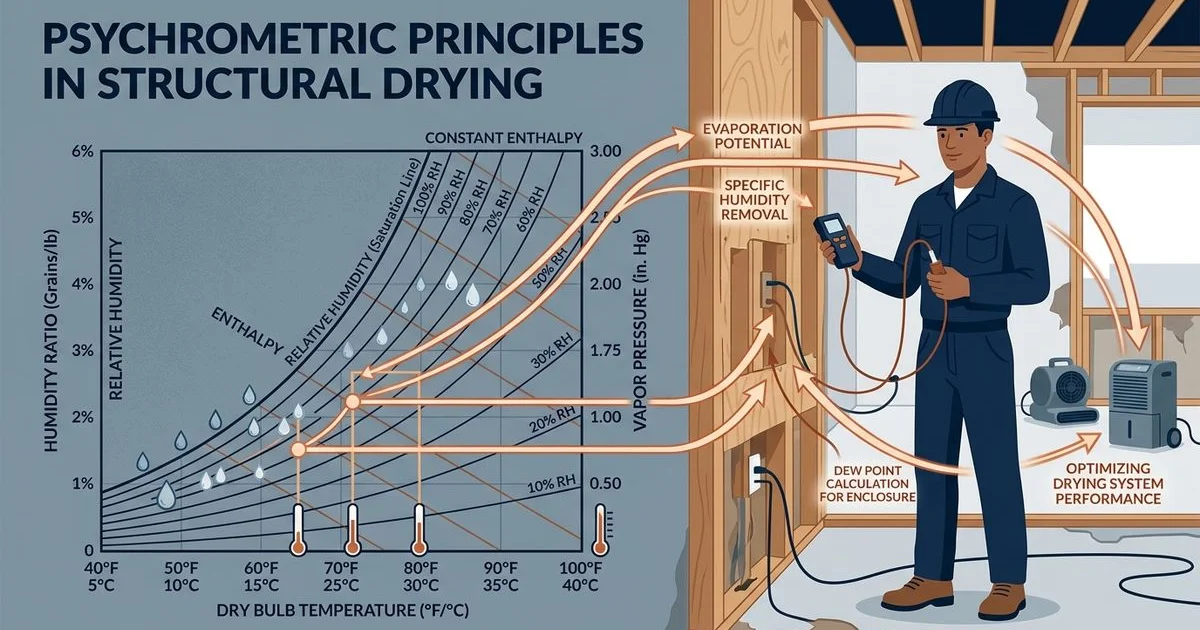
Mold can begin growing on damp surfaces in as little as 24 to 48 hours. Our technicians prevent this rapid growth by mastering the science of psychrometrics. This specific term refers to the structural drying science of managing moisture in the air.
The core idea
The primary goal of psychrometric drying explained simply is moving water from wet materials into the surrounding air through evaporation. Our crews focus entirely on controlling the vapor pressure differential between those wet materials and the room’s atmosphere.
How Humidity Impacts Evaporation:
- Low Air Humidity: Creates a large vapor pressure differential for rapid drying.
- High Air Humidity: Shrinks the differential and completely stalls evaporation.
- Maximum Capacity: Reaching 100% relative humidity forces water to condense back onto surfaces.
We know that air can only hold a specific amount of moisture at a given temperature. This absolute limit dictates when materials stop releasing water. Air can absorb more water below that threshold, but condensation forms once it exceeds that limit.
Our structural drying strategy keeps the air exceptionally dry with a low grain count per pound. This allows wet building materials to continuously release trapped moisture. We actively pull that absorbed water out of the environment using high-capacity dehumidification.
Statistics show that 98% of US basements will face water issues eventually. Our methods ensure those damp spaces recover fully.
The variables we manage
Managing a drying environment requires strict control over three specific metrics. Our technicians constantly monitor these variables to maximize efficiency. Getting one of these numbers wrong can delay the project by several days.
Temperature
Warmer air naturally holds significantly more moisture. We typically maintain the drying environment between 75 and 85 degrees Fahrenheit. This specific temperature range maximizes the overall evaporation potential.
Relative Humidity
Relative humidity, or RH, is the percentage of moisture the air currently holds. Our working target is generally below 60% to keep the process moving. Pushing the RH below 40% aggressively accelerates the drying speed. We avoid dropping it below 30% because extreme dryness can crack hardwood floors and damage remaining materials.
Absolute Moisture
Grain count, or GPP, measures the absolute grains of moisture per pound of dry air. Our team relies on this metric because two rooms at the exact same RH can dry at very different rates depending on their temperature. Grains per pound provides the most accurate and true measure of atmospheric moisture.
Why LGR dehumidifiers matter
Standard refrigerant dehumidifiers simply pass humid air over a cold coil to collect condensation. Our experience shows this setup works fine when ambient humidity remains high. The system stops collecting water effectively as the air gets drier because the dew point drops below the coil temperature.
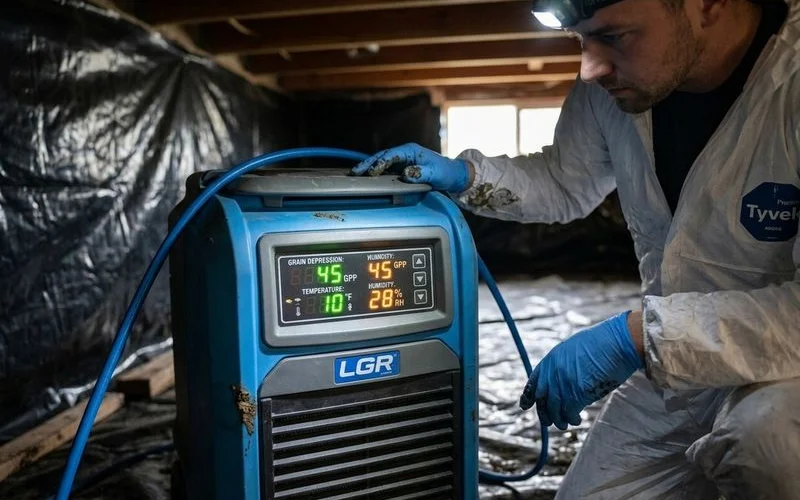
We upgrade the process by utilizing Low-Grain Refrigerant, or LGR, technology. These advanced units feature a specialized heat exchanger that pre-cools incoming air and reheats it after the coil. Our top-tier models, like the Phoenix DryMAX XL Pro and the Dri-Eaz LGR 7000XLi, perform exceptionally well in demanding US climates.
This advanced engineering allows them to extract moisture down to grain depressions of 30 GPP or even lower. We rely on LGR units late in the cycle when surfaces feel dry but interior structural materials still hide trapped water. Standard dehumidifiers simply lack the power to pull this deep moisture out.
| Feature | Standard Dehumidifiers | LGR Dehumidifiers |
|---|---|---|
| Best Use Case | High ambient humidity | Low ambient humidity and deep structural drying |
| Technology Base | Single cold condensation coil | Heat exchanger with pre-cooling system |
| Moisture Extraction Limit | Struggles rapidly as the air dries | Extracts moisture down to 30 GPP or lower |
Our structural drying service utilizes LGR dehumidifiers as standard equipment on every single job. They are never treated as an optional premium upgrade.
How we set up the system
Every successful water damage restoration project starts with precise mathematical calculations. Our specialists evaluate the affected space to determine the exact equipment needed. The first step involves measuring the cubic footage of the drying envelope to establish a baseline.
Essential Setup Calculations
We account for several critical factors before placing a single fan. The most important variables include:
- The specific number and type of wet materials present, such as drywall, framing, subfloor, or hardwood.
- The required dehumidifier capacity measured in pints per day at target conditions.
- The strategic number and placement of air movers focused on materials needing the fastest drying times.
- The physical containment strategy used to limit the drying zone and drastically improve efficiency.
Advanced Monitoring Tools
The deployed equipment runs continuously without interruption. Our technicians verify progress daily using highly accurate diagnostic tools. Ambient hygrometers track the surrounding humidity levels inside the contained space.
We utilize industry-leading devices like the Protimeter Surveymaster for both surface and pin-style readings to measure material moisture content. Advanced FLIR MR277 infrared thermography cameras help visually verify temperature anomalies and hidden leaks behind walls. Our comprehensive daily logs document the entire trend to ensure the environment moves steadily toward the dry standard.
What “dry standard” actually means
The term “dry standard” does not refer to a universal, fixed percentage. Our industry defines this standard through the IICRC S500 guidelines as the moisture content that matches an unaffected reference material. This means we compare the wet spot to a similar, dry material in an undamaged area of the exact same building. The baseline shifts significantly depending on your specific location and local climate conditions.
The dry standard is entirely relative, meaning a perfectly dry piece of framing in Arizona will have a very different baseline moisture content than one in Florida.
Consider drywall in a typical US Pacific Northwest home, which might naturally hold an 8% moisture content baseline. Our readings might show the affected drywall spiking to 25% after a pipe burst. The drying system must keep running until that material returns completely to its original 8% baseline.
We require multiple readings across the damaged zone to confirm the equilibrium moisture content is stable. The equipment only comes down when all affected materials officially reach this verified dry standard. Our crews never remove dehumidifiers early just to save time.
Rental billing cycles never dictate when the machines get turned off. We let the hard data and specific meter readings drive every single decision.
Why this matters to you
Homeowners facing a flooded basement or burst pipe do not need a degree in thermodynamics to hire the right help.
Our goal is to give you the basic knowledge required to vet a professional restoration company effectively. You must understand that any crew running fans without actively controlling the room’s humidity is doing the job incorrectly.
We strongly advise against hiring contractors who pull their equipment based on calendar days rather than actual moisture readings. A competent crew protects your property by documenting daily moisture logs and adjusting the setup based on verifiable data.
Our commitment to these strict scientific principles ensures your home avoids secondary mold damage. Proper psychrometric drying protects the structural integrity of your house and helps justify your insurance claim.
We consider this detailed, data-driven approach the true definition of professional structural drying.
If you suspect hidden moisture or need emergency water removal, contact a certified structural drying expert today to schedule an immediate inspection.
Frequently Asked Questions
What's psychrometrics?
Why not just open windows?
What's an LGR dehumidifier?
Related Guides
Burst and Frozen Pipe Water Damage: What to Do
Burst pipe or frozen pipe leak? Safe shutoff, cleanup, and what's covered by insurance — for Seattle homeowners.
Flooded Basement Cleanup: Steps and Timeline
Flooded basement? Safe steps, the cleanup process, and what affects how long it takes — for Seattle homeowners.
How Fast Do You Need to Extract Water to Prevent Mold?
Mold can grow in 24-48 hours after water damage. Here's the science behind the timeline and why fast extraction matters.
Can You Save Wet Hardwood Floors?
Wet hardwood floors don't have to be a total loss. Injectidry drying can save many wood floors — here's how it works and when it's worth trying.
Learn more about Emergency Water Removal & Extraction
Talk to a real local dispatcher 24/7. Certified technicians on-site in 60 minutes — direct insurance billing.