We constantly see the panic that sets in when a historic wood floor gets completely soaked. The immediate assumption is that those 80-year-old boards are ruined forever.
Our experience shows that with rapid intervention, the salvage rate for solid wood is incredibly high.
Let’s look at the science behind moisture extraction and walk through the exact methods professionals use to save wet hardwood floors.
The wrong answer is “tear it out”
We always tell clients that demolition should be the absolute last resort for wood floor water damage repair. Tearing out wet boards permanently destroys irreplaceable material in older homes.
Our crews regularly work in Queen Anne craftsman, Capitol Hill bungalows, and Ballard farmhouses with original 80-year-old red oak or fir. Those vintage floors possess a unique patina and grain that modern lumber simply cannot replicate.
This demolition approach is usually a massive financial mistake:
Our recent data matches the 2026 Angi reports, which place new hardwood installation between $6 and $25 per square foot for basic materials. Sourcing reclaimed, old-growth wood to match a historic Seattle home pushes that cost dramatically higher.
We prefer drying in place because it preserves the home’s character and saves thousands of dollars. The right answer is usually a targeted mat-and-suction setup.
How Injectidry works
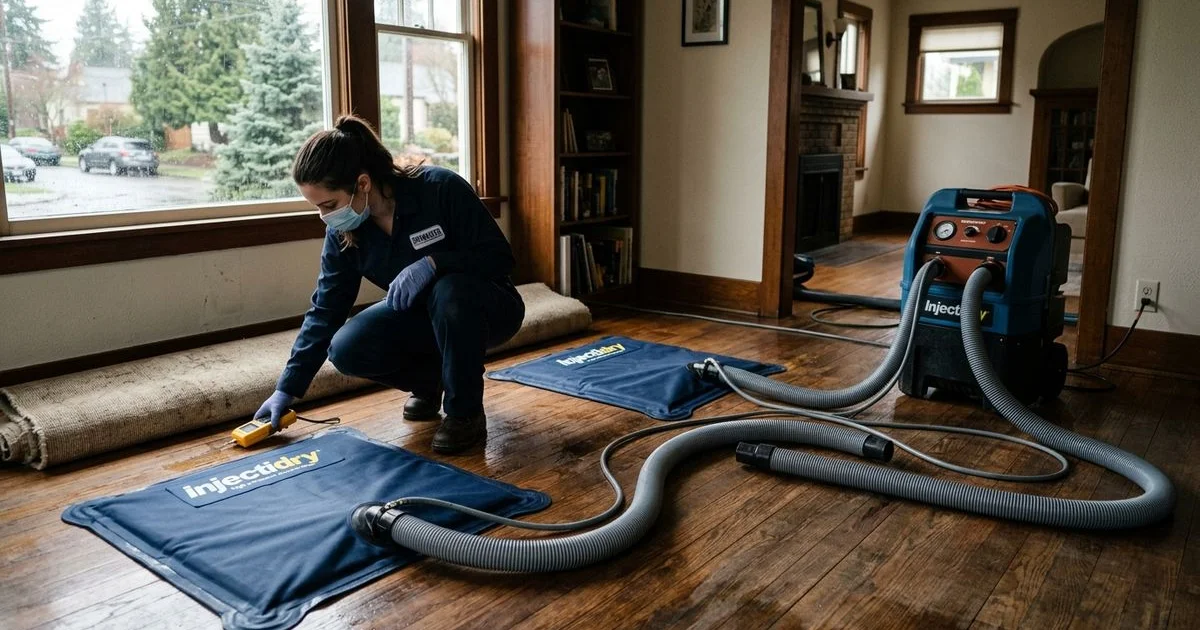
We rely on the Injectidry system to extract moisture without lifting a single plank. Field crews lay heavy rubber mats with sealed edges directly over the saturated hardwood.
Our technicians connect these mats to an industrial regenerative blower, like the Injectidry HP60 or HP-PLUS. This unit pulls negative pressure across the floor surface at up to 120 cubic feet per minute.
A constant vacuum stream draws trapped moisture from inside the wood cavity straight out into the air. Our team loves this setup because the entire process runs on a standard 12-amp circuit, preventing overloaded residential electrical panels.
| Metric | Moisture Percentage Goal |
|---|---|
| Typical Saturated Floor | 20% to 25% |
| NWFA Normal Target | 6% to 9% |
| Acceptable Dry Standard | 8% to 12% |
The system combines targeted suction with low-grain refrigerant dehumidifiers to manage the ambient room humidity. We use this dual approach to facilitate rapid wet hardwood drying and drop saturated wood back to normal levels over three to five days. This non-invasive method completely preserves the original finish, the historic patina, and the structural integrity of the boards.
When it works
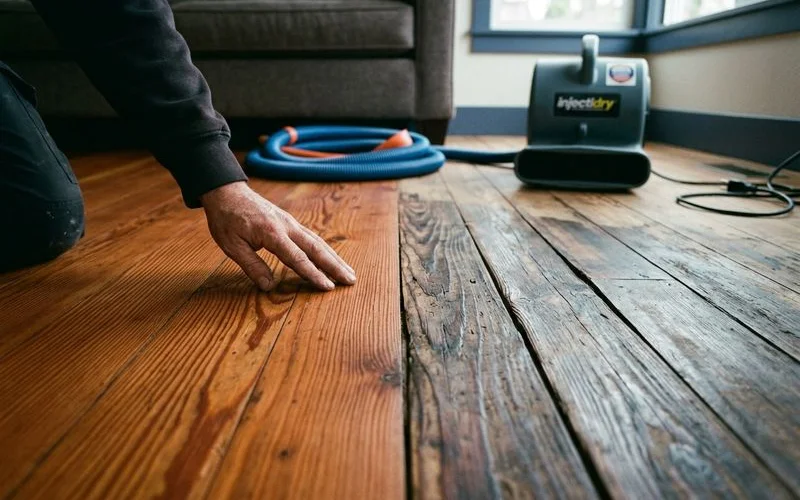
We achieve the highest success rates when mitigation starts immediately after the initial leak. The Institute of Inspection, Cleaning and Restoration Certification S500 standard outlines the ideal conditions for salvage.
- The water was Category 1 (sanitary) or Category 2 (gray water).
- emergency water extraction begins within the critical 24 to 48-hour window recommended by FEMA.
- The wood is fully saturated but has not permanently cupped or buckled.
- The underlying subfloor remains structurally sound and has not delaminated.
- The home’s HVAC system allows for tight ambient humidity control.
Our emergency responders prioritize rapid water removal to maximize this specific salvage window. Fast action stops the wood from absorbing more water and expanding past its breaking point.
This Class 4 drying situation requires specialized equipment to pull moisture out of dense materials effectively. Our field data shows that the salvage rate on original hardwood is exceptionally high for typical Pacific Northwest homes when treated promptly.
When it doesn’t
We must acknowledge that some flooded floors are beyond repair. Certain physical changes in the cellular structure of the wood are permanent and irreversible.
Our assessment process carefully checks for limitations that make the Injectidry system ineffective.
- Permanent cupping: The bottom of the boards has expanded so much that the wood will never lay flat again.
- Buckled boards: The nails or glue have completely failed, lifting the wood off the subfloor.
- Category 3 water: Grossly contaminated liquid, like sewage or floodwater, mandates the immediate removal of porous materials.
- Engineered hardwood delamination: The internal adhesives break down under prolonged moisture, causing the top wear layer to peel away.
- Prolonged exposure: Water that sat for a week or more usually means wood rot has already started.
Technicians always attempt a professional drying setup first if the conditions look even marginally favorable. The final call on replacement should only happen after hard data shows the moisture content has stopped dropping.
We ensure that the original material receives every possible chance to survive. Our priority is to protect your property’s value by exhausting all restoration options before turning to demolition.
The cost difference
We consistently save property owners thousands of dollars by choosing restoration over replacement. The financial math heavily favors specialized drying, especially for historic homes built with rare materials.
Our records show that drying a single room of 1920s-era fir flooring might cost $1,500 to $3,000 as part of the larger mitigation effort. Tearing out and replacing that same floor with similarly sourced old-growth wood often runs between $15,000 and $30,000.
| Factor | Structural Drying | Full Replacement |
|---|---|---|
| Average Cost | $1,500 to $3,000 | $15,000 to $30,000+ |
| Material Impact | Keeps original patina | Requires new lumber |
| Project Timeline | 3 to 5 days | Weeks of construction |
We regularly work with insurance carriers to cover either approach for qualifying damage events. The salvage route preserves historical character that a simple cash payout simply cannot replicate.
This method allows you to keep your original architectural details intact while avoiding a messy, prolonged demolition zone. Our clients overwhelmingly prefer the faster, cleaner restoration process.
What to do if your hardwood is wet right now
We need you to take immediate, specific actions to protect your floor before help arrives. The wrong DIY steps will accelerate the damage and guarantee a complete replacement project.
- Never cover the wet wood with plastic. Plastic traps moisture against the grain and rapidly accelerates cupping.
- Do not point household fans at the floor. Surface drying without ambient humidity control pulls the wood in different directions. The top shrinks while the bottom remains swollen, causing severe warping.
- Call for professional extraction immediately. The longer the water sits, the lower the overall salvage rate becomes.
Our crews can be on-site at properties across Seattle and Snohomish County within 60 minutes, 24 hours a day. The exact same emergency trip that handles the initial water extraction will also configure the hardwood drying system.
This rapid response provides the absolute best possible outcome for your damaged property. We are ready to dispatch a specialized truck to your home the moment you call.
We treat every flooded house as an opportunity to rescue valuable, historic materials. The technology exists to save wet hardwood floors, provided the response is swift and methodical.
Our specialized tools and trained technicians are standing by to evaluate your unique property situation.
Reach out to the emergency response team right now so a professional can protect your home’s foundation and character.
Frequently Asked Questions
How quickly do hardwood floors need to be dried?
What's Injectidry and how does it work?
How can I tell if my hardwood is salvageable?
Related Guides
Burst and Frozen Pipe Water Damage: What to Do
Burst pipe or frozen pipe leak? Safe shutoff, cleanup, and what's covered by insurance — for Seattle homeowners.
Flooded Basement Cleanup: Steps and Timeline
Flooded basement? Safe steps, the cleanup process, and what affects how long it takes — for Seattle homeowners.
How Fast Do You Need to Extract Water to Prevent Mold?
Mold can grow in 24-48 hours after water damage. Here's the science behind the timeline and why fast extraction matters.
Psychrometric Structural Drying Explained
The science of professional structural drying — temperature, humidity, vapor pressure — and why it matters for water damage restoration.
Learn more about Emergency Water Removal & Extraction
Talk to a real local dispatcher 24/7. Certified technicians on-site in 60 minutes — direct insurance billing.