You know how a seemingly minor plumbing leak can suddenly trigger a massive, expensive tear-out. We see this progression constantly in the field.
That rapid escalation usually comes down to how the water is classified.
Recent 2026 US data shows the average home water damage claim now tops $13,954. Because of that financial risk, adjusters rely heavily on strict category definitions to approve coverage.
Our team will break down the category 1 2 3 water classification, explain the hidden risks of each, and outline the exact steps to take when disaster strikes. Having the water damage categories explained clearly is the first step in protecting your property. Let’s look at the science behind the standard.
Water damage categories explained: what the classification actually means
A water category defines the level of contamination present in the source, which directly dictates the safety protocols and cleaning methods required. The IICRC S500 categories establish these safety guidelines to keep both property owners and restoration crews safe from pathogens.
We rely on this classification system as the absolute building code for restoration work. It determines everything from the required personal protective equipment (PPE) to which structural materials can actually be saved. Treating a burst supply line the same way as a sewer backup is incredibly dangerous.
Water damage and freezing currently account for nearly 28% of all US homeowners insurance claims. The assigned category gets used by professionals to decide three major factors:
- Urgency: How quickly the moisture must be extracted.
- Scope: Whether materials like drywall and carpet padding are salvaged or trashed.
- Risk: The level of bacteria, chemicals, or biohazards present.
Category 1: clean water
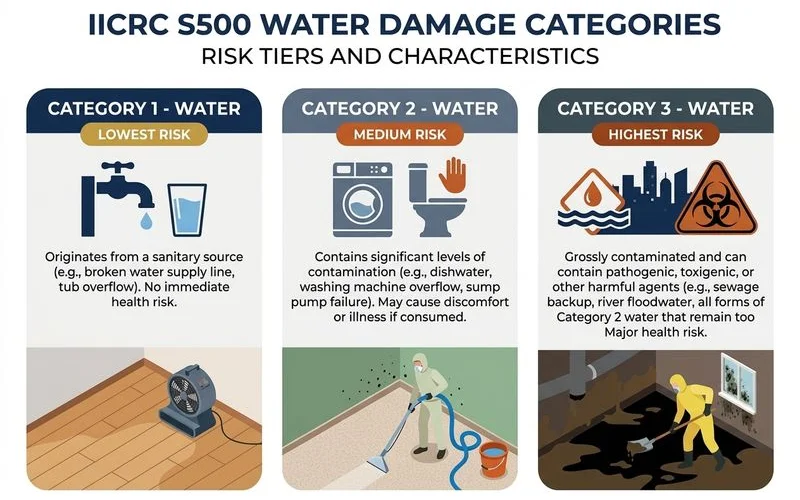
Category 1 water originates from a completely sanitary source and poses no substantial health risk to humans upon direct contact. Common examples include broken supply lines, overflowing bathtubs, melting ice, or rainwater that enters directly through a roof leak before touching other surfaces.
The key defining trait is that the liquid is entirely clean at its point of origin. We often see homeowners underestimate these situations because the puddle looks harmless. However, a slow plumbing leak wasting 250 gallons a month quickly creates severe hidden structural decay.
National average costs for Category 1 restoration in 2026 typically range from $1,383 to $3,500.
Common residential sources for this clean classification include:
- Burst indoor plumbing pipes
- Leaking water heater tanks
- Faucets accidentally left running
- Direct rainwater intrusion
Category 1 water does not stay clean indefinitely. Once it sits for 24 to 48 hours, it begins absorbing dirt, bacteria, and chemical contaminants from carpet padding and dust.
Our crews consider room temperature a major factor here, as warm indoor conditions aggressively accelerate this bacterial growth. By the time a full two days pass, the situation officially degrades into a hazardous Category 2 classification.
Restoration for this initial clean stage heavily focuses on rapid extraction, commercial dehumidification, and verifying no hidden moisture remains.
Category 2: gray water
Category 2 water contains a significant amount of chemical, biological, or physical contamination and can cause illness if contacted or consumed. Sources frequently include washing machine overflows, dishwasher discharge, sump pump failures, or toilet overflows containing only urine.
The presence of these contaminants completely changes the required cleanup protocol. We must approach these intermediate jobs with elevated caution and specific safety gear. Affected porous materials, such as carpet padding and fiberglass wall insulation, usually need immediate removal instead of simple drying.
EPA-approved cleaners and targeted antimicrobial treatments are mandatory for disinfecting all remaining hard surfaces.
The 48-Hour Degradation Window
If left untreated, this gray water breaks down into a highly toxic Category 3 biohazard within roughly 48 hours. The US EPA firmly recommends that wet porous materials be completely dried within this tight window to prevent aggressive mold colonization.
Our technicians stress that response speed is critical, even if the spill does not look particularly filthy. Yesterday’s simple washing machine malfunction easily transforms into today’s serious health hazard if the moisture sits unchecked.
Professional restoration costs for this intermediate level typically jump 20% to 30% higher than clean water jobs, averaging $3,000 to $5,500 nationwide.
Category 3: black water
Category 3 water is grossly contaminated and carries severe pathogens, organic waste, or toxic chemicals that pose immediate human health risks. This highly dangerous classification includes raw sewage backups, outside floodwaters carrying soil bacteria, and any fluid that has touched feces.
This level of contamination is legally treated as a severe biological hazard. We deploy highly trained HAZWOPER-certified crews equipped with full-body Tyvek suits, heavy-duty respirators, and protective boot covers to handle these losses safely. All affected porous materials, including drywall and carpeting, must be completely torn out and disposed of according to strict environmental regulations.
Vulnerability to serious illness after direct or indirect exposure to this black water exceeds 90%, making DIY cleanup incredibly dangerous.
Specific health threats found in Category 3 events include:
- E. coli bacterial infections
- Hepatitis A exposure
- Norovirus transmission
- Agricultural pesticides from surface runoff
For local US properties, the most frequent black water scenarios involve basement flooding from severe storms and backed-up floor drains. Hospital-grade disinfectants are applied aggressively to treat all remaining structural framing and concrete subfloors.
Our emergency protocol ensures that no cross-contamination occurs in the unaffected areas of your home. The cost for this intensive biohazard remediation reflects the severe risk, often reaching $5,000 to $12,000 for standard residential repairs in 2026.
How categories affect insurance and timing
Insurance adjusters use the water category to determine the exact scope of coverage, the necessary mitigation steps, and the final payout amount. Your policy coverage hinges on accurate classification documentation provided right from the start.
Category 1 losses typically move much faster through the claims process because the affected materials are highly salvageable. We find that Category 2 and 3 losses require significantly more administrative effort to justify the added costs of demolition and protective gear. Adjusters will immediately halt approvals if they do not see clear, standards-compliant evidence detailing why materials were removed.
Average Restoration Timelines & Costs (2026 US Estimates)
| Water Classification | Typical Source | Average Repair Cost | Required Action |
|---|---|---|---|
| Category 1 | Burst supply line | $1,383 - $3,500 | Rapid extraction and drying |
| Category 2 | Dishwasher backup | $3,000 - $5,500 | Antimicrobial treatment and partial removal |
| Category 3 | Raw sewage flood | $5,000 - $12,000+ | Full demolition and biohazard sanitization |
The most practical takeaway for any homeowner facing a sudden leak is to act immediately. A seemingly harmless clean water pipe burst officially turns into gray water after just 48 hours.
Our team emphasizes that calling for emergency water removal within the first few hours drastically lowers the total project expense. It also significantly increases the percentage of your personal belongings that can be safely saved.
For severe, active sanitary failures, prompt professional intervention is absolutely non-negotiable. Our dedicated Category 3 sewage cleanup service manages the entire biohazard process, from safe extraction straight through to final deodorization and insurance reporting. Getting these water damage categories explained before a disaster strikes gives you the knowledge to act fast and stay safe.
Frequently Asked Questions
Is Category 2 gray water dangerous?
Can I clean up clean water myself?
What makes water Category 3?
Related Guides
Does Homeowners Insurance Cover Water Damage?
Sudden water damage is usually covered; gradual leaks often aren't. What's covered, what to document, and how direct billing cuts cost.
How Long Does Professional Structural Drying Take?
Professional structural drying usually takes 3-5 days. What affects the timeline and how we monitor to the dry standard.
7 Signs of Hidden Water Damage in Your Home
Recognize the early warning signs of water damage behind walls, under floors, and in your crawl space — before it becomes a mold problem.
How the Water Damage Insurance Claim Process Works
Step by step: from filing the claim to documenting damage, working with the adjuster, and getting paid for water damage restoration.
Need help with water damage?
Talk to a real local dispatcher 24/7. Certified technicians on-site in 60 minutes — direct insurance billing.