More survives than you’d expect
From what we have seen across countless US disaster recoveries, the initial shock of a house fire makes everything look like a total loss. Homeowners often assume the worst when walking through soot-covered rooms.
At Seattle Water Damage Restoration, our team knows that the visual damage rarely tells the whole story.
We often successfully restore fire damaged belongings that clients thought were ruined forever.
Those sentimental and irreplaceable pieces actually have an excellent chance of recovery. Let’s look at the data behind what survives, what needs replacement, and how the professional recovery process actually works.
What typically survives
Hard, non-porous items and professionally treated textiles survive a house fire with remarkable frequency. In fact, modern US restoration facilities see an 85% to 95% success rate for salvaging smoke-damaged fabrics.
Electronics present another strong recovery opportunity. Devices can achieve a 70% to 80% survival rate if professional remediation starts within 48 to 72 hours. Fast action prevents acidic soot from causing permanent corrosion on internal circuit boards.
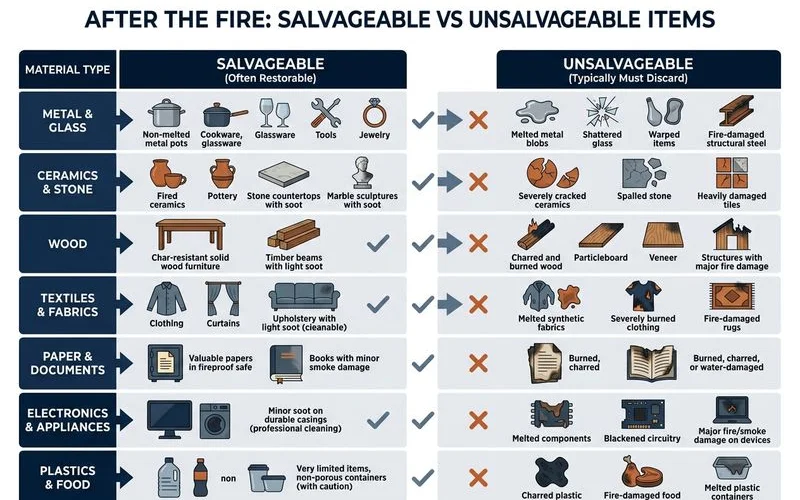
We categorize salvageable items into a few main groups. This breakdown helps you understand what stands the best chance of recovery.
Hard goods and sealed surfaces:
- Sealed wood furniture showing moderate smoke residue.
- Dishes, glassware, and ceramic kitchen cookware.
- Metal items, including jewelry and durable silverware.
- Lacquered or painted surfaces depending on direct heat exposure.
Documents, textiles, and electronics:
- Heavily smoke-damaged clothing and specific upholstery.
- Water-logged photos, bound books, and historical records.
- Important financial documents and legal papers.
- Certain household electronics treated before corrosion sets in.
What typically doesn’t survive
Items directly touched by flames, melted by intense heat, or deeply contaminated by fire retardants rarely survive. Porous materials like standard carpet padding absorb toxic chemicals and become an automatic total loss.
Safety guidelines dictate the immediate disposal of certain household goods. For example, FDA guidelines require discarding all food, daily medications, and cosmetics after a fire. Extreme heat quickly compromises the chemical stability of these daily products.
Our crews always point out the items that present safety risks. The lists below highlight the belongings you should plan to replace.
Direct heat and fire casualties:
- Belongings burned, completely charred, or permanently melted.
- Plastics warped beyond repair by extreme ambient temperatures.
- Household electronics with melted internal plastic components.
- Any possessions sitting immediately next to the fire’s origin point.
Heavily contaminated household materials:
- Soft living room furnishings with deep smoke penetration.
- Standard carpet padding and all exposed wall insulation.
- Open pantry food items and prescription medications.
- Everyday cosmetics and personal hygiene products.
The restoration process: How we restore fire damaged belongings
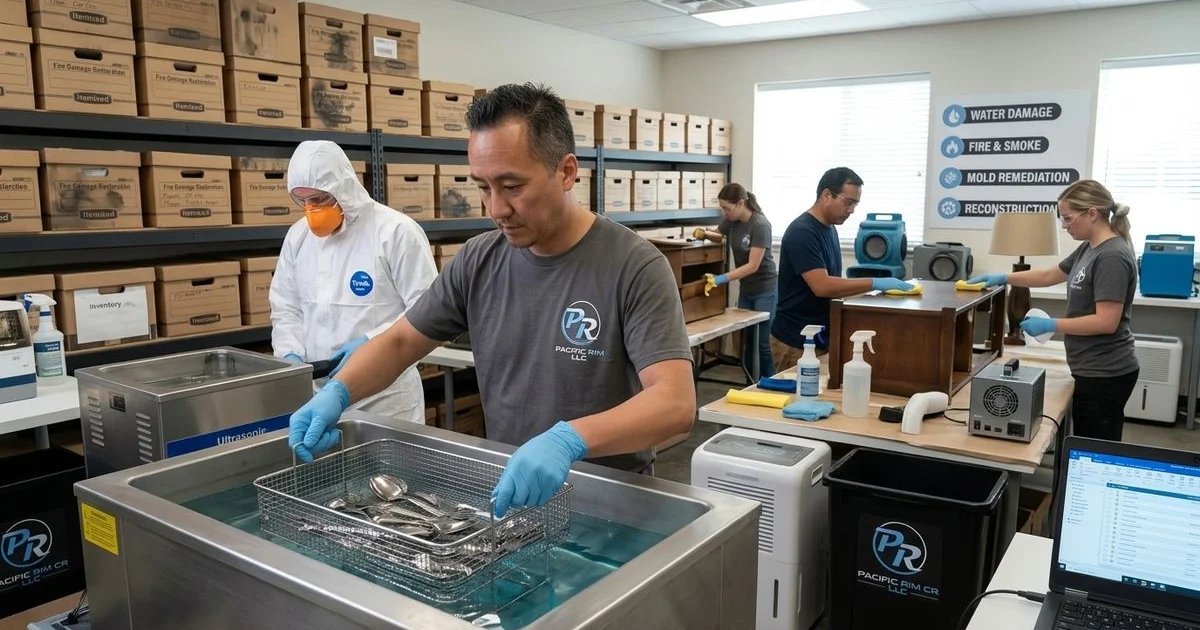
Our contents restoration fire protocol relies on a precise, multi-step process to secure, clean, and return your items. This systematic approach moves damaged goods to a specialized facility for material-specific cleaning.
Pack-out
The pack-out phase creates a comprehensive, photo-mapped inventory of your possessions before anything leaves the property. Crews label, record, and pack each item into a specific tracked container.
We maintain strict chain-of-custody documentation throughout this entire step. This detailed tracking proves essential when filing your final insurance claim.
Off-site assessment
At the cleaning facility, technicians sort all belongings by category and damage severity. Salvageable pieces move immediately to the active cleaning phase.
Unsalvageable items receive highly detailed documentation. Technicians take photos and write descriptions to support your replacement cost research for the insurance scope.
Cleaning
Technicians apply specific chemical and mechanical treatments chosen for each unique material. The right cleaning method prevents further degradation while safely removing toxic soot.
Standard cleaning methods include:
- Ultrasonic cleaning: Submerges hard goods in a 40 kHz sound wave bath to remove stubborn residue gently.
- Hand cleaning: Carefully targets delicate electronics and specific unsealed woods.
- Ozone deodorization: Neutralizes deep odors in textiles using sealed chambers for up to 48 hours.
- Specialty restoration: Connects fine art and valuable antiques with niche industry experts.
Document and photo restoration
Water and smoke-damaged papers undergo specialized freeze stabilization to prevent rapid mold growth. Technicians must act within 48 hours to stop irreversible biological damage to the paper fibers.
Vacuum freeze-drying systems drop the temperature to roughly -20°F to -40°F. This specific low-pressure environment turns frozen moisture directly into vapor without damaging the ink.
Modern US facilities can often complete this document drying cycle in 5 to 7 days. The results frequently bring waterlogged, unreadable papers back to a fully usable condition.
Storage
Cleaned items sit in a secure, climate-controlled facility while contractors finish the structural repairs on your house. Proper climate control prevents any secondary humidity damage to your newly restored goods.
We coordinate this storage phase directly with your structural rebuild schedule. Typical storage durations run from one to six months depending on the overall reconstruction timeline.
Move-back
Once the house is structurally sound, crews return your possessions using the original mapped inventory. The delivery team places every piece of furniture and every box exactly where it belongs.
We conduct a final quality verification walk-through with you. This step ensures everything meets your expectations before you sign off on the fire and smoke damage restoration service.
Insurance treatment
Standard US homeowners policies cover contents restoration under Coverage C, which typically equals 50% to 70% of your total dwelling coverage. Your insurance carrier normally pays for both the specialized cleaning of salvageable goods and the replacement of destroyed items.
Standard policies often cap payouts for specific valuable categories. For instance, typical plans limit jewelry replacement to $1,000 or $2,500 unless you purchased a separate scheduled endorsement.
We frequently help homeowners manage these specific personal property limits. Proper documentation makes a massive difference in your final claim approval.
Coverage C typically pays for:
- The complete cleaning and restoration of all salvageable belongings.
- Off-site pack-out labor, specialized facility cleaning, and storage costs.
- Actual cash value or replacement cost for completely unsalvageable losses.
- Unique handling requirements for verified high-value or antique items.
Because standard limits often fall short of replacing an entire modern household, thorough photo inventories are vital. Detailed item descriptions and accurate replacement cost research heavily support your claim.
What to prioritize
When you first walk through your property, prioritize photographing every room before the pack-out crews begin their work. You need to identify and point out the pieces that hold the highest financial or emotional value.
Our crews rely on your guidance to identify unusual or custom items. Tell the pack-out team immediately about anything requiring specific handling or climate control.
Focus on pointing out:
- Sentimental pieces that hold deep personal meaning.
- High-value antiques or custom-built furniture.
- Financial documents needed for immediate recovery.
- Items requiring immediate specialized climate handling.
Most property owners are amazed by how effectively we can salvage fire damaged items. The initial sight of heavy soot makes everything look like a total loss.
After professional intervention, the typical result is highly positive. You get most of your belongings back in excellent condition. Proper technical methods make it entirely possible to restore fire damaged belongings, leaving only the truly destroyed items to be replaced and compensated by insurance.
Frequently Asked Questions
What about photos and important documents?
Should I try to clean items myself?
What's not salvageable?
Related Guides
Fire Damage: Restore or Rebuild?
After a fire, when does restoration make sense vs. tearing down and rebuilding? How the decision is made.
Smoke Odor and Soot Removal: How It Works
Soot removal and smoke-odor elimination — thermal fog, hydroxyl, and ozone explained.
What to Do After a House Fire
After the fire department leaves, what's next? Safety, documentation, immediate calls, and the fire restoration process.
Learn more about Fire & Smoke Damage Restoration
Talk to a real local dispatcher 24/7. Certified technicians on-site in 60 minutes — direct insurance billing.