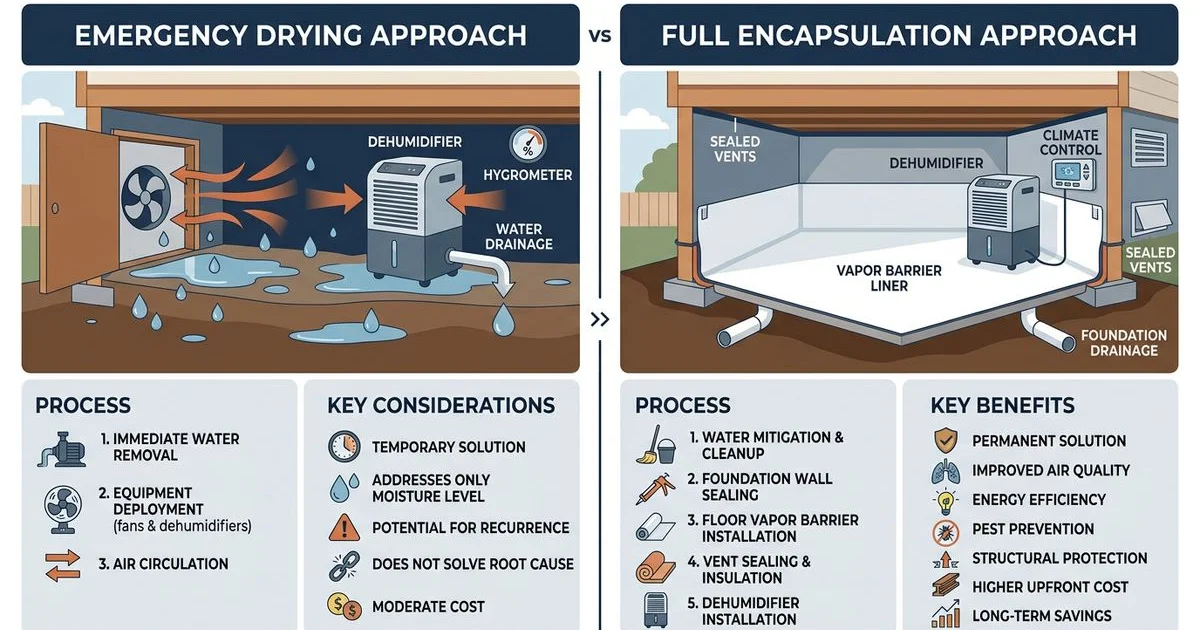
Two different things people often confuse
Our team regularly meets property owners who think a single service will solve a flooded subfloor. You likely want the water gone and a guarantee it will never return.
A single service rarely accomplishes both goals.
We have seen the confusion between crawl space drying vs encapsulation cause major headaches during sudden property emergencies. Water damage forces a quick choice between an emergency response and a long-term upgrade.
Mitigation stops the immediate bleeding. Encapsulation serves as the permanent cure.
Mitigation drying
Mitigation drying is an emergency response that extracts standing water and returns wet building materials to a safe baseline. The main objective is stabilization after a sudden pipe burst or storm intrusion. Our technicians follow the strict ANSI/IICRC S500 guidelines for professional water damage restoration.
Measuring temperature and relative humidity determines the exact equipment needed to pull moisture out of the wood structure. This data-driven approach prevents secondary issues like mold growth in your floor joists. We start by establishing psychrometric baselines using thermal hygrometers.
The mitigation scope typically includes:
- Extracting standing water quickly
- Removing ruined insulation and contaminated debris
- HEPA-vacuuming exposed joists and subfloors
- Applying an antimicrobial fogging treatment
- Placing commercial LGR dehumidifiers to reach dry standards
- Documenting the entire loss for insurance billing
When this emergency service is appropriate:
- Following a specific event like a burst pipe or sewer backup
- If the area was consistently dry before the sudden emergency
- After a plumber has identified and repaired the source leak
- When addressing an insurance-covered scope of work
A standard crawl space dry out averages $1,500 to $2,000 in the US for 2026. Severe flooding can push that figure closer to $8,000.
Most homeowner insurance policies cover this cost for sudden and accidental water events. Our crews usually complete the entire drying process in about five to seven days.
Once mitigation finishes, the area is dry. Leaving dirt floors exposed means ground moisture can eventually cause new problems down the road.
Encapsulation
Encapsulation is a permanent structural upgrade that completely seals your foundation from ground moisture and humid outside air. The process transforms a damp dirt pit into a clean and conditioned environment. Our team recommends this proactive service to prevent future decay and improve the air you breathe upstairs.
Nearly half of the air circulating inside your living areas originates beneath your floors. A sealed system actively controls that environment to boost your indoor air quality. We install a heavy-duty 20-mil reinforced polyethylene vapor barrier to block ground evaporation entirely.
The full encapsulation scope adds these permanent features:
- Installing a reinforced wall and floor vapor barrier
- Sealing all foundation vents against outside air
- Adding specialized crawl space dehumidifiers
- Repairing chronic source issues like poor drainage
- Setting up a remote long-term moisture monitor
When this permanent upgrade is appropriate:
- Battling chronic dampness, recurring mold, or musty smells
- Living in an older home with an exposed dirt floor
- Experiencing high indoor humidity or winter window condensation
- Protecting your long-term property value and family health
In 2026, a full encapsulation project averages about $5,500 nationwide. Larger footprints or complex drainage needs can push the investment between $5,000 and $15,000.
Our experience shows that homeowner insurance rarely covers this preventative work. You can often recoup a significant portion of this out-of-pocket expense over time.
Field studies from Advanced Energy indicate that a properly sealed foundation can reduce your annual HVAC energy usage by 15 to 20 percent. The barrier keeps cold winter drafts and hot summer humidity away from your floorboards.
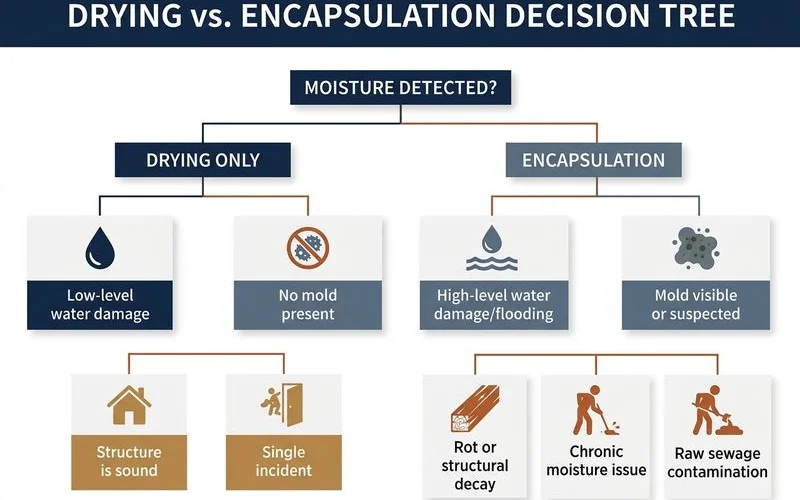
The crawl space drying vs encapsulation decision framework
Choosing between mitigation vs encapsulation depends entirely on your property history and the source of the moisture. A sudden pipe failure requires a different strategy than decades of slow ground evaporation. We guide property owners through this exact decision framework every week.
Evaluating the existing conditions dictates the proper next step. The following three scenarios cover almost every situation you might face.
Scenario 1: Just had a water event, no prior history
Mitigation drying provides the exact fix for this situation. Your insurance policy typically covers the immediate emergency response to remove the standing water.
Our team focuses purely on the extraction and drying phases here. The original construction requires no major upgrades if the existing vapor barrier and foundation vents perform correctly. Emergency drying restores the area to its pre-loss condition effectively.
Scenario 2: Just had a water event, crawl space was already marginal
This situation requires emergency mitigation now and scheduled encapsulation later. Your insurance carrier will pay to extract the floodwater and dry the structural wood. They will not pay to fix preexisting issues like exposed dirt or failing insulation.
Many homeowners use the insurance payout to handle the immediate crisis first. Families then plan the long-term upgrade for a few months down the road. Our scheduling sequence makes the future sealing project much easier and more cost-effective.
Scenario 3: No water event, but persistent crawl space problems
Encapsulation offers the only permanent solution for chronic environmental issues. Insurance policies do not cover slow continuous damage from seasonal humidity or ground evaporation. The investment comes entirely out of your pocket as a planned home improvement.
We know a damp dirt floor will constantly introduce moisture into your floor joists and insulation. Upgrading the system prevents costly structural rot and stops musty odors from invading your living room. The long-term energy savings and health benefits easily justify the upfront price tag.
How they work together
Emergency drying and permanent sealing work sequentially to rescue and protect a damaged foundation. Combining the two services ensures the structure is perfectly dry before locking it behind a thick plastic barrier. We highly recommend completing both phases together to reduce total labor costs.
Overlapping the logistics saves a tremendous amount of setup time. A single contracting team can handle the transition smoothly without repeating the initial cleanup steps.
| Feature | Phase 1: Mitigation | Phase 2: Encapsulation |
|---|---|---|
| Primary Goal | Stop emergency damage and dry wood | Prevent future moisture and seal area |
| Typical Duration | 5 to 7 days | 5 to 10 days |
| Funding Source | Usually covered by homeowner insurance | Homeowner out-of-pocket investment |
| Key Equipment | LGR dehumidifiers and air movers | 20-mil vapor barrier and permanent HVAC |
Phase 1 (The Insurance-Covered Emergency):
- Pumping out the standing floodwater
- Tearing out ruined materials
- Treating all structural joists
- Reaching verified IICRC S500 dry standards
- Fixing the primary water source
Phase 2 (The Homeowner-Paid Upgrade):
- Laying the heavy-duty plastic liner
- Taping and sealing foundation walls
- Installing the permanent conditioning unit
- Running a final system verification
Handling these tasks separately means setting up containment and access protocols twice. Combining them provides a smooth transition from disaster recovery to a permanent upgrade.
Our coordinated approach keeps your property safe and minimizes disruption to your daily life.
What our crawl space cleanup and encapsulation service does
The cleanup team delivers both emergency water extraction and permanent structural sealing under a single roof. This comprehensive approach means you never have to coordinate between separate cleanup crews and installation contractors.
We assess your exact structural needs during the initial inspection.
Clear communication drives our entire process. Your assigned project manager will explain exactly what your home requires to stay healthy and protected.
How we handle your specific project:
- If you only need mitigation, we extract the water and document everything for your insurance adjuster.
- If a permanent seal is the best route, we provide a transparent quote detailing the scope and exact pricing.
- If your home requires both services, we sequence the phases efficiently and split the billing appropriately.
Our technicians never push an expensive sealing package when standard drying will solve the issue. Applying cheap plastic over a wet dirt floor will not mask chronic moisture problems either.
The honest and effective solution always depends on the specific data gathered beneath your floorboards. If you are still weighing crawl space drying vs encapsulation, contact our team today for a thorough inspection and professional recommendation.
Frequently Asked Questions
Will insurance pay for encapsulation?
If I just dry it, will the problem come back?
Can I encapsulate later?
Related Guides
Crawl Space Encapsulation Explained
What encapsulation actually involves — materials, process, and what you get for the cost.
Crawl Space Stack Effect & Your Indoor Air Quality
Stack effect means about half the air upstairs comes from the crawl space. Why that matters for PNW homes.
Water in Your Crawl Space: What to Do
Standing water in your crawl space is a structural and air-quality risk. Causes, immediate steps, and the cleanup process.
Learn more about Crawl Space Cleanup & Encapsulation
Talk to a real local dispatcher 24/7. Certified technicians on-site in 60 minutes — direct insurance billing.