The core principle
We often hear from homeowners who feel completely overwhelmed by insurance terminology after a sudden flood or pipe burst. That confusion is completely understandable, and the first question people ask is always about what is pre-loss condition.
Our team knows that figuring out exactly what your policy covers is usually the most stressful part of the recovery process. The dividing line between a standard payout and a massive out-of-pocket expense usually comes down to one specific concept. We need to talk about “pre-loss condition.”
This term is the foundation of standard US property insurance policies like the widely used ISO HO-3 form.
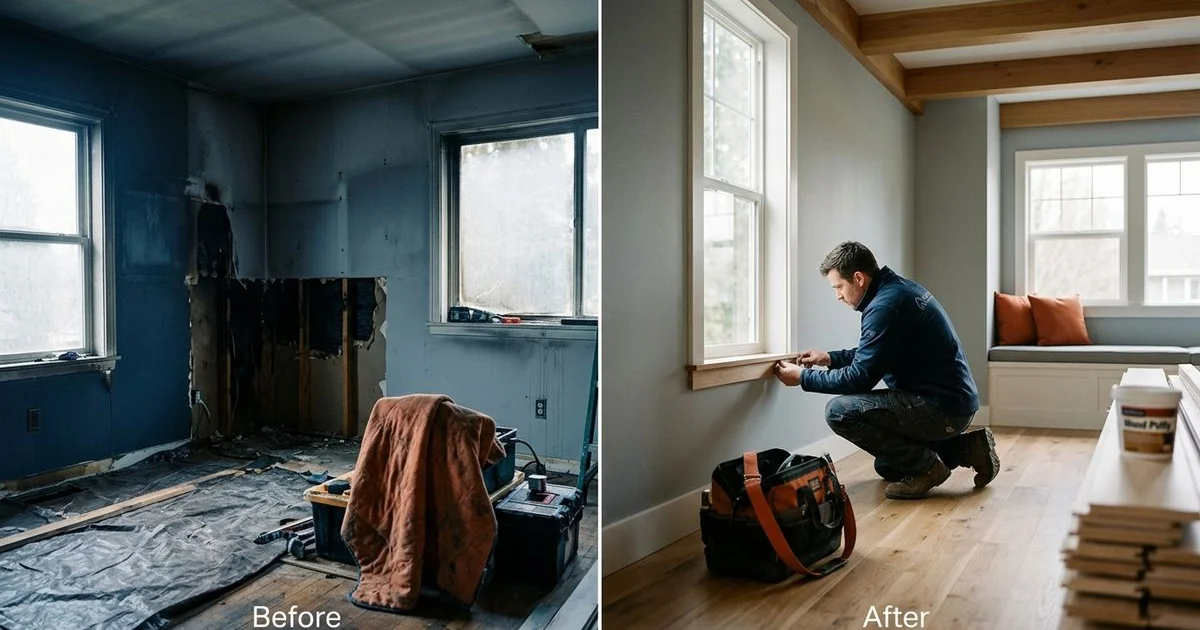
Our daily work revolves around this specific standard. It simply means your property should be restored to the exact state it was in the minute before the damage occurred.
We will break down exactly what this standard covers and what it excludes. This guide details how building codes affect your claim and offers practical advice for getting your house back to normal.
What pre-loss condition includes
Pre-loss condition includes the exact materials, layout, and functionality your home featured before the disaster. Your insurance carrier is required to indemnify you, meaning they must make you financially and structurally whole again based on that specific baseline.
We follow strict industry guidelines, like the IICRC S500 standard for water damage, to ensure these baseline repairs meet professional requirements. The restoration process aims for visual continuity and functional equivalence across several key areas.
- Materials of equivalent quality. Our crews replace damaged items with materials of the same grade. Builder-grade laminate floors get replaced with new builder-grade laminate, while custom hardwoods warrant custom hardwood replacement.
- Same general layout. The wall goes back exactly where it was. Cabinet placement matches the original footprint, and fixture locations remain identical unless a new building code forces a change.
- Same general appearance. We aim for a uniform appearance, matching colors, textures, and trim profiles to the undamaged sections of your home. National Association of Insurance Commissioners (NAIC) guidelines often require this uniform look to prevent mismatched patchwork repairs.
- Code compliance. Restoration must meet current building codes. Older homes frequently have grandfathered electrical or plumbing elements that require upgrading during the rebuild.
- Functional equivalence. We restore your plumbing, electrical, and mechanical systems to safe working condition.
What pre-loss condition doesn’t include
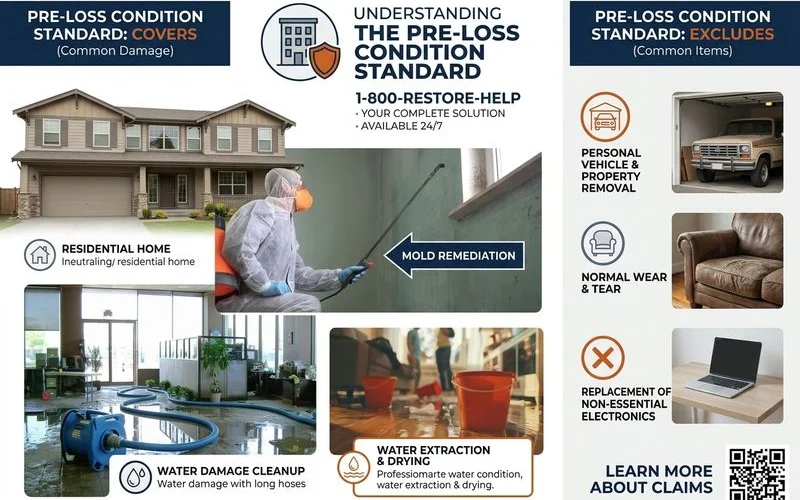
Pre-loss condition does not cover elective upgrades, cosmetic perfection, or the repair of pre-existing wear and tear. The insurance standard is designed to fix the sudden damage from your specific claim, not to act as a general home improvement fund.
Our project managers frequently discuss these limitations with homeowners to prevent surprises during the billing phase. You will need to pay out of pocket if you request changes that fall outside the approved scope of loss.
| Excluded Category | Practical Example | Who Pays |
|---|---|---|
| Upgrades (Betterment) | Swapping damaged formica counters for new quartz. | Homeowner |
| New Additions | Adding a kitchen island that was not there before the flood. | Homeowner |
| Pre-existing Damage | Fixing window rot that existed long before the pipe burst. | Homeowner |
| Cosmetic Perfection | Straightening out-of-square corners typical of 1920s construction. | Homeowner |
We refer to these homeowner-requested upgrades as “betterment” in the insurance industry. Your insurance policy will cover the cost of the baseline replacement, and you simply cover the difference for the nicer material.
Code upgrades as a special case
Code upgrades are mandatory safety updates required by your local municipality, and they are usually covered if you have Ordinance and Law coverage on your policy. A standard homeowners policy does not automatically pay to bring an older home up to current 2026 building codes without this specific endorsement.
We highly recommend checking your declarations page for this coverage, which typically provides an additional 10% to 25% of your total dwelling limit. Missing this coverage is a massive risk. Unplanned code compliance can increase your total repair costs by up to 50% on older properties.
When restoration triggers current-code requirements, common examples include:
- Electrical upgrades to current safety standards in rebuilt areas.
- Plumbing changes to meet modern municipal codes.
- Insulation upgrades to current R-values for energy efficiency.
- Egress window size requirements in bedrooms.
- Hardwired smoke and carbon monoxide detector installations.
Our teams manage these requirements directly with local building inspectors. The insurance adjuster will typically cover these code upgrades separately from the main damage scope, provided your policy includes the right endorsement.
Vintage and historic homes
For older Seattle homes in neighborhoods like Queen Anne or Ballard, pre-loss condition requires a specialized approach to matching historic materials. Original construction elements like old-growth fir or custom plaster are rarely available at modern big-box hardware stores.
We understand that preserving the character of these homes is a top priority for local residents. Insurance covers a reasonable matching effort, meaning they will pay for a very close replica if an exact match is impossible to find.
Our in-house reconstruction approach for vintage homes focuses on authenticity. The process typically involves several specific steps.
- Salvaging and reusing original materials where structurally possible.
- Sourcing authentic matching replacements from local architectural salvage yards, such as Earthwise Architectural Salvage or Ballard Reuse.
- Custom-milling period-correct trim and millwork when commercial options are not available.
- Sourcing vintage hardware, like manganese glass door knobs or antique hinges.
- Documenting all material choices with you and the insurance adjuster.
We never settle for generic replacements when restoring a historic property. A mediocre contractor might try to install modern MDF trim in a 1910 craftsman, but true restoration demands historical accuracy.
Quality differences between contractors
The quality of a restoration project depends entirely on the contractor’s specific experience with the insurance claims process. Two companies can both claim to restore your home to pre-loss condition, but the final results will look dramatically different.
We see general contractors struggle with insurance work because they lack expertise in specialized estimating software like Xactimate, which adjusters require. A dedicated insurance restoration contractor understands both the construction side and the strict claims documentation process.
Where Quality Differences Appear
- Materials sourcing. A great contractor makes the effort to match original materials perfectly. A poor contractor accepts whatever is currently on sale at the supply house.
- Craftsmanship and finishing. Finish carpentry, paint matching, and drywall texturing vary widely between crews. Quality reconstruction looks like the water damage never even happened.
- Attention to detail. Top-tier project management ensures that unsalvaged areas blend perfectly into the newly built sections. Mediocre reconstruction leaves visible transitions, slightly off-kilter trim, and mismatched paint sheens.
Our restoration crews focus heavily on completing every single item on the final punch list. You want a team that remembers the small fixes, rather than one that rushes off to the next job. Both approaches might technically meet the loosest definition of pre-loss condition, but only one truly restores the value of your home.
Setting expectations
When you walk into the restored home for the first time, you should immediately feel like you are back in your own space. The rebuilt sections might feature slightly newer materials, but they must blend naturally and be functionally equivalent to the untouched areas.
We use a comprehensive punch list process to guarantee this standard is met. A common mistake homeowners make is signing the final completion certificate before physically testing systems like the plumbing or HVAC.
If a specific detail does not meet your expectations, you need to talk directly to your project manager. Punch list completion is a mandatory part of the restoration project, and no reputable company signs off until the work is completely right.
Our policy is that the project only closes when both you and the insurance adjuster sign off on the final results. That signature is the practical definition of what it takes to restore home to pre-loss condition. Call our emergency response team today if you need expert help assessing your property damage.
Frequently Asked Questions
Does pre-loss condition mean exact replica?
Can I upgrade during restoration?
What if the original materials aren't available anymore?
Related Guides
Learn more about Reconstruction & General Contracting
Talk to a real local dispatcher 24/7. Certified technicians on-site in 60 minutes — direct insurance billing.