You know how the restoration cycle usually goes. A pipe bursts, panic sets in, and the immediate question is how long your property will remain a construction zone.
We hear this question every single day from homeowners across the US. Recent 2026 data from J.D. Power reveals the average property damage claim now takes about 44 days from loss to final payment.
“A fast response during the first 24 hours is the single biggest factor in reducing your overall restoration timeline.”
That timeline feels incredibly long when you are living with exposed drywall.
We are going to break down the exact phases of a typical project so you can plan your life. Let us look at the complete mitigation to rebuild timeline, what actually causes delays, and practical ways to speed up your insurance claim.
The realistic timeline
A standard residential restoration project timeline takes between three and six weeks from the initial call to the final coat of paint. The exact answer depends heavily on the scope of the damage and your insurance carrier’s approval speed.
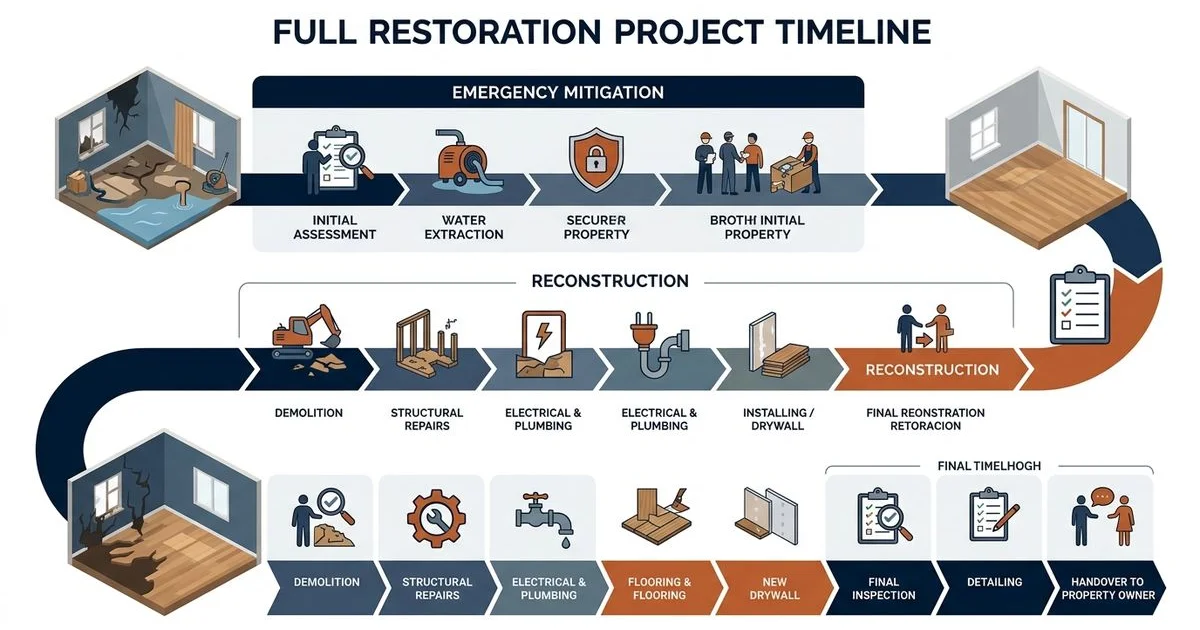
Our team approaches every project in six distinct phases to keep the chaos organized. This phased approach ensures nothing gets skipped, especially during the critical first week.
Phase 1: Emergency response (Day 0)
Emergency response happens within the first 24 hours to stop the spread of damage and secure the property. The clock starts ticking the moment you discover the disaster.
We prioritize rapid dispatch because standing water begins degrading building materials almost immediately. The CDC and EPA warn that dangerous mold can begin forming within 24 to 48 hours under the right conditions.
When you call for help:
- Dispatch occurs in 5 to 15 minutes.
- Arrival happens within 60 minutes inside the primary service area.
- Initial documentation and Category 1 through 3 water classification take 1 to 2 hours.
- Mitigation work begins immediately with extraction and board-up procedures.
- Insurance notification occurs within hours.
By the end of day one, the immediate emergency is contained. Your property is documented with baseline photos to protect your insurance claim.
Phase 2: Mitigation (Days 1-7)
The mitigation phase takes 5 to 10 days for residential losses to prevent further damage and prepare the structure for rebuilding. This is the heavy lifting of extraction and structural drying.
Our technicians follow the ANSI/IICRC S500 standard, which is the internationally recognized playbook for professional water damage restoration. Strict adherence to this standard prevents costly secondary damage.
Data from recent restoration studies indicates that properly documented moisture monitoring reduces total project duration by an average of 18 percent. We deploy high-performance LGR (Low-Grain Refrigerant) dehumidifiers and axial air movers to hit these strict drying goals.
The duration varies based on the class of water absorption:
| Damage Class | Saturation Level | Typical Drying Time |
|---|---|---|
| Class 1 | Minimal absorption in a small area | 2 to 3 days |
| Class 2 | Significant absorption, wicking up walls | 3 to 5 days |
| Class 3 | Heavy saturation from above (ceilings, insulation) | 5 to 7 days |
| Class 4 | Deep saturation in hardwood, plaster, or concrete | 10 to 14 days |
For fire damage, board-up and tarping happen on day one, followed by soot removal over days two through five. Mold remediation requires containment setup on day one, material removal over the next three days, and antimicrobial treatments running through day seven.
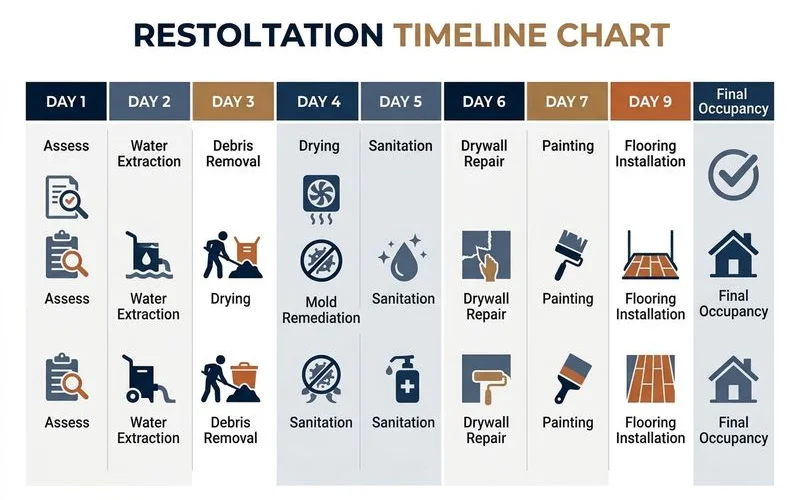
Phase 3: Scope alignment with insurance (Days 3-14)
Scope alignment typically requires 1 to 3 weeks to finalize, as adjusters evaluate the damage and approve the reconstruction budget. This administrative phase runs parallel with your physical mitigation.
We submit a highly detailed initial scope of work directly to your carrier to start the negotiation process. Adjusters are often overloaded with claims, which makes comprehensive documentation your best defense against delays.
In 2026, some states like Texas require insurance companies to acknowledge a claim within 15 days, but the back-and-forth over pricing often stretches the timeline. The most common bottleneck is missing paperwork or disputes over standard versus custom material replacement.
The core steps of scope alignment include:
- An adjuster site visit to verify mitigation documentation.
- Submission of the line-item reconstruction estimate.
- Multiple rounds of negotiation to secure full approval.
- Filing for local building permits if the scope requires structural changes.
Our in-house advocates push this process forward daily. Carrier response times dictate the actual pace of approval, but proactive communication keeps your file at the top of the pile.
Phase 4: Pre-reconstruction (Days 14-21)
This preparation phase lasts 1 to 2 weeks for standard projects while materials are ordered and work crews are scheduled. Everything must be staged perfectly before hammers start swinging.
We require a final scope agreement from the insurance carrier before ordering materials to ensure you are not hit with surprise out-of-pocket bills. The current US construction market adds a layer of difficulty to this stage.
Key pre-reconstruction milestones:
- Securing the final written approval from the adjuster.
- Ordering materials, prioritizing long-lead items immediately.
- Packing out and storing your personal contents.
- Finalizing any complex municipal permits.
Industry reports from early 2026 show that supply chain disruptions and tariffs on imported metals are causing spot shortages. Some projects that rely on specialty items face delays extending up to three months.
We strongly advise against custom orders to keep your project moving. Standardized materials, domestic cabinetry, and readily available finishes will shave weeks off your wait time.
Phase 5: Reconstruction (Weeks 3-12+)
The physical rebuild phase ranges from a few weeks for a single room to eight months for a major whole-house reconstruction. This is where your property is put back together.
Our in-house reconstruction team handles the entire build process to eliminate the downtime of finding outside contractors. The same project manager who oversaw your initial emergency response stays with you through the final inspection.
Recent construction pricing data puts the average cost of professional water damage repairs between $20 and $37 per square foot. Budget and timeline scale directly with the size of the loss.
Typical Reconstruction Schedules
Small projects involving a single room or minor water damage take 1 to 3 weeks to reconstruct. These jobs generally fall in the $5,000 to $25,000 range.
Medium projects covering multiple rooms or light fire damage require 4 to 8 weeks. These scopes usually range from $25,000 up to $100,000.
Large projects, such as major fire recovery or a whole-house rebuild, take 3 to 8 months.
The Reconstruction Workflow
We follow a strict sequence to ensure quality control at every step. Skipping the proper order leads to rework and unnecessary delays.
The standard progression includes:
- Drywall installation, taping, and finishing.
- Upgrading insulation to current 2026 energy codes.
- Laying down hard surface flooring or carpet.
- Installing cabinetry and vanities.
- Completing paint and interior trim work.
- Reinstalling plumbing fixtures and finalizing electrical connections.
Phase 6: Move-back and final (Weeks varying)
The final move-back and wrap-up phase takes 1 to 2 weeks to complete the final walkthroughs and invoicing. This marks the transition from a construction site back into your home.
We coordinate the return of your stored contents once the dust has settled and the paint is completely dry. A thorough walkthrough ensures every detail meets your expectations before we close the file.
The final steps include:
- Unpacking and arranging your contents from storage.
- Completing the final punch-list of minor touch-ups.
- Hosting the final inspection with the insurance adjuster.
- Handing over all warranties and project documentation.
- Submitting the final invoice to release the last insurance check.
Total timelines by project type
Estimating the total timeline requires looking at the combined duration of mitigation, insurance approvals, and reconstruction. These baseline estimates give you a realistic picture of the road ahead.
| Damage Type | Scope Description | Estimated Total Timeline |
|---|---|---|
| Small Water Damage | Single room, Category 1 water | 3 to 6 weeks |
| Medium Water Damage | Multiple rooms, moderate saturation | 6 to 12 weeks |
| Major Water Damage | Extensive flooding, Class 4 materials | 3 to 6 months |
| Small Mold Remediation | Localized growth, under 10 square feet | 4 to 6 weeks |
| Major Mold Remediation | Widespread contamination, HVAC involvement | 8 to 16 weeks |
| Small Fire Damage | Kitchen fire, smoke damage in one zone | 6 to 12 weeks |
| Major Fire Damage | Structural charring, heavy water from suppression | 4 to 12 months |
| Total Loss | Whole-house rebuild from the foundation | 12 to 18 months |
What can speed things up
Proactive decisions and clear communication are the most effective ways to accelerate a restoration timeline. Every day saved during the planning phase translates to a faster move-in date.
We recommend engaging a professional restoration team within hours of a loss, rather than waiting days. Early extraction stops water from wicking into subfloors and framing, drastically reducing the reconstruction scope.
Here is what keeps a project on the fast track:
- Providing comprehensive insurance documentation and pre-loss photos from day one.
- Making swift, firm decisions on your reconstruction scope.
- Selecting domestic, standard-grade materials instead of imported specialty items.
- Working with a cooperative, responsive insurance adjuster.
- Utilizing a single contractor for both mitigation and rebuilding.
What slows things down
Delays and administrative bottlenecks are the primary culprits behind stalled restoration projects. Recognizing these hurdles early allows you to sidestep the most common traps.
Our crews often see projects stall when homeowners change their design choices midway through the rebuild. Rerouting plumbing or swapping cabinet dimensions requires new permits and fresh material orders.
The most frequent causes of project delays include:
- Waiting too long to call for professional water extraction.
- Engaging in protracted disputes over the insurance settlement amount.
- Demanding vintage material matching that requires custom fabrication.
- Discovering hidden code upgrades required by 2026 municipal building standards.
- Finding additional hidden damage, like structural rot, during the demolition phase.
What to expect from us
You can expect honest timeline estimates and complete transparency from the moment we arrive on site. A realistic water damage rebuild timeline protects you from false hope and unnecessary frustration.
We provide weekly progress updates during the reconstruction phase so you never have to guess what happens next. If a supply chain issue or an insurance delay pops up, you will be the first to know.
Restoring a severely damaged property is a long and exhausting process. We focus on keeping you informed and in control, ensuring the timeline is managed by professionals who have your back.
Call our emergency dispatch line today to secure your property and start your recovery process.
Frequently Asked Questions
Can the timeline be compressed?
What's the biggest delay factor?
Do you handle the entire timeline?
Related Guides
Learn more about Reconstruction & General Contracting
Talk to a real local dispatcher 24/7. Certified technicians on-site in 60 minutes — direct insurance billing.