You probably know how chaotic a home looks right after a major leak or fire. We see homeowners try to salvage their belongings by shifting them from room to room. That approach usually leads to secondary damage and much higher replacement costs.
Our experts at Seattle Water Damage Restoration rely on a proven strategy to protect your investments. Sending your items to an off site cleaning climate controlled storage facility stops the damage clock immediately.
Let’s look at the specific cleaning methods and why proper storage matters so much.
Why contents go to a dedicated facility
Items leave your house because an active restoration site is highly hazardous to delicate materials. Our priority is moving your belongings to a secure facility to stop ongoing deterioration. There are several verifiable reasons for this relocation protocol.
- Active restoration zone dangers: Your home is full of construction dust and equipment. Airborne particles can recontaminate cleaned surfaces in a matter of minutes. We cannot risk ruining the restoration contents cleaning process by leaving items in a dirty environment.
- Secondary damage prevention: Unaddressed indoor moisture leads directly to destructive mold colonization. Moving items out within the first 72 hours prevents this secondary damage.
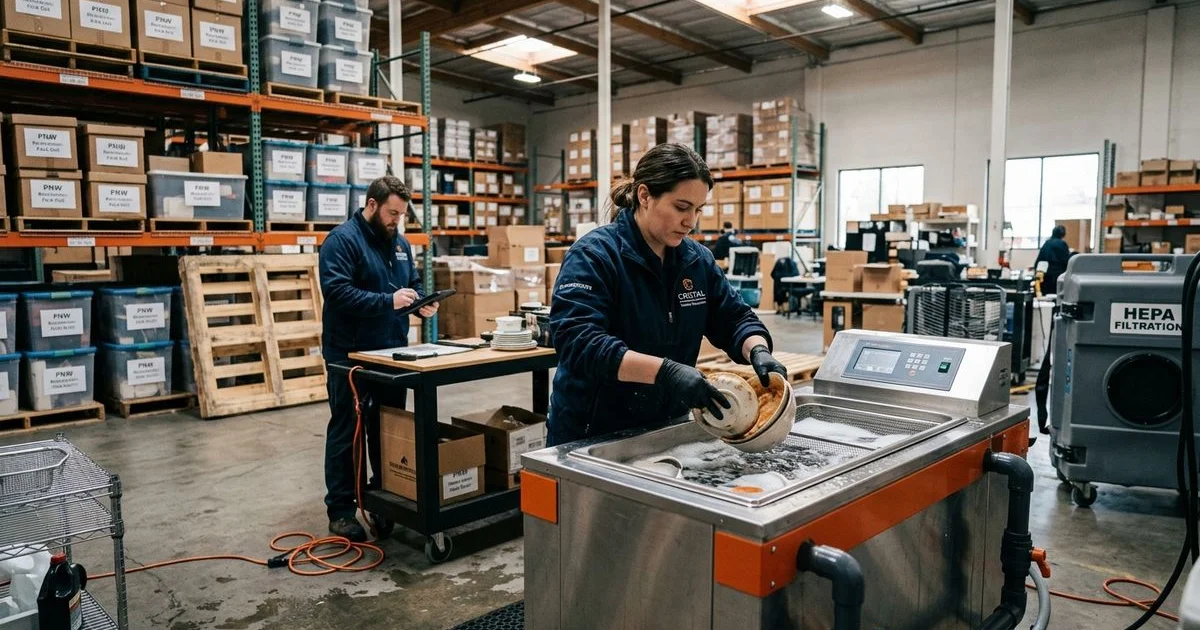
- Specialized cleaning equipment: Professional restoration tools remain at the central facility. We use industrial ultrasonic cleaners and specialized chambers that cannot operate in a normal home.
- Climate control and security: Storage during the rebuild usually runs for weeks or months. A monitored, climate-controlled setting prevents secondary issues like wood swelling.
The cleaning process by item type
Different materials require entirely different treatment methods. We evaluate every single piece to determine the safest decontamination route.
Hard goods (metal, glass, ceramic, sealed wood)
Hard, non-porous items undergo a deep liquid bath using sound waves. This process knocks away microscopic soot and grime from every crevice. We rely heavily on ultrasonic cleaning technology for these durable items.
The machine submerges items in a specialized cleaning solution. High-frequency sound waves, typically running at 40 kHz, pass through the fluid. These waves create millions of tiny vacuum bubbles that collapse violently against the object. We use this microscopic scrubbing effect to remove stubborn residue safely.
| Feature | Details |
|---|---|
| Primary Method | Ultrasonic cleaning (40,000 vibrations per second) |
| Effective For | Dishes, hardware, glass, ceramics, small metal objects |
| Limitations | Unsafe for porous paper, fabrics, or unsealed wood |
| Typical Frequency | 20 kHz to 40 kHz depending on the item durability |
Furniture
Furniture restoration is a highly specialized craft handled item by item. Moisture and humidity changes dictate exactly how these pieces get treated. Our technicians hand-clean most large furnishings to protect delicate finishes.
According to the 2026 IICRC S500 guidelines, wood responds constantly to its environment’s equilibrium moisture content. High humidity conditions will quickly warp expensive cabinetry and split table legs. We combat this by utilizing specialized treatments based on the specific material.
- Sealed wood: A damp wipe with a mild, pH-neutral cleaner removes surface soot.
- Upholstered items: Technicians use specialized extraction equipment to lift contaminants from the fabric.
- Leather goods: Specialty leather soaps and conditioners prevent cracking.
- Painted or lacquered finishes: Gentle dry-sponging prevents accidental stripping of the topcoat.
Textiles and soft goods
Clothing and fabrics require heavy-duty laundering or specialized gas chambers. Smoke odors cling aggressively to soft materials. We select the textile cleaning method based on the severity of the contamination.
- Laundering: Heavy-duty washing handles standard clothing and washable items.
- Dry cleaning: Delicate fabrics that cannot tolerate water receive chemical cleaning.
- Ozone treatment: Odor removal requires running items through sealed ozone chambers for 12 to 48 hours. We monitor the concentration, often keeping it around 2 to 5 ppm, to prevent damage to elastics.
- Specialty restoration: Vintage rugs and delicate upholstery go to specialized partners.
The climate controlled storage restoration process ensures these fabrics stay fresh after cleaning.
Documents and photographs
Wet paper goods undergo a rapid freezing process to stop mold. This service has saved countless family photos and vital legal records. We pack these sensitive items and send them immediately to a blast freezer.
The goal is to reach a core temperature of -20°F as quickly as possible. Vacuum freeze-drying then sublimates the water. This means the ice crystals vaporize directly into a gas without ever melting back into a liquid state. Our partners use this exact protocol to prevent ink migration and paper warping.
Electronics
Water-damaged electronics face a ticking clock against internal corrosion. The damage is rarely instant but rather a slow degradation of the copper traces. We move quickly to disconnect power and assess the salvageability of your devices.
The first 0 to 4 hours offer the best chance of recovery, boasting a nearly 90% success rate. If left untreated for 24 hours, the minerals in the water begin oxidizing the exposed metals. We document any items damaged beyond repair for your insurance claim. Not all devices survive, but rapid professional intervention saves more than most people expect.
What off site cleaning climate controlled storage actually means
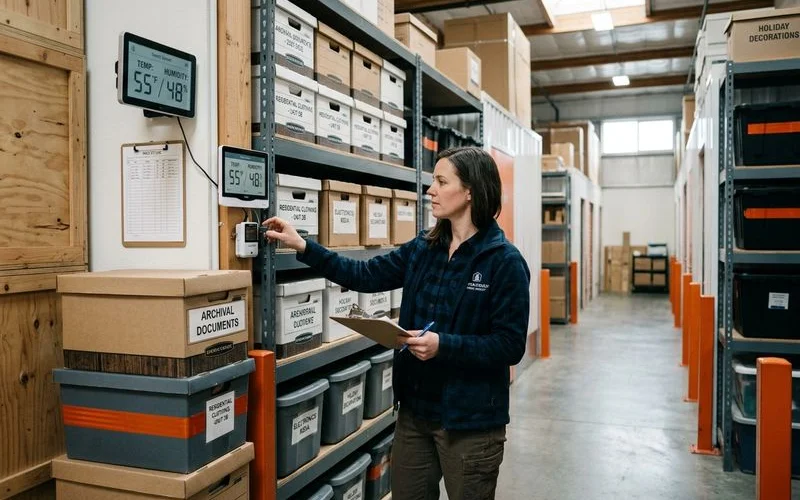
True climate control goes far beyond a basic air conditioner. A dedicated environment actively manages humidity, airflow, and temperature. We maintain these strict standards to preserve the cleaning work already completed.
| Environmental Factor | Industry Standard Target |
|---|---|
| Temperature | Stable at 65°F to 75°F |
| Relative Humidity | Kept between 30% and 50% RH |
| Air Quality | HEPA-filtered with regular exchange cycles |
| Security & Safety | 24/7 monitoring, restricted access, fire sprinklers |
Without these specific conditions, items sitting in a standard warehouse for six months will suffer. Damp items will grow mold, and fluctuating humidity will crack solid wood furniture. Our strict climate protocols prevent photos from deteriorating and electronics from condensing.
Access during storage
You are never permanently locked out of your stored belongings. Homeowners frequently need to retrieve seasonal clothing or vital documents during long rebuilds. We make sure you can get what you need through a simple appointment process.
Your dedicated project manager will coordinate the retrieval of specific boxes. You simply take what you need, and the rest remains secure. We see families use this service regularly to maintain a sense of normalcy.
Sustained quality
Cleaned items must remain pristine until your house is ready. A dusty construction zone will undo thousands of dollars of restoration work. Our contents pack-out and storage service guarantees your belongings stay protected.
Items do not sit in a damp unit slowly re-contaminating. They rest in a stable environment for weeks or months. We deliver everything back to your restored home in the exact same condition it achieved during cleaning. That level of sustained quality is the true value of the storage investment.
What it costs
Restoration storage costs combine the physical footprint and the cleaning labor. Prices reflect the intense security and specific climate requirements of the facility. We work directly with your insurance adjuster to cover these expenses under your primary policy.
- Storage footprint: Climate-controlled units typically average $1.15 to $1.80 per square foot nationally in 2026. Comprehensive restoration handling and heavy R-19 insulation often bring the total to around $1 to $3 per square foot monthly.
- Cleaning labor: Fees vary wildly based on the contamination level and the specific methods required.
- Logistics: Pack-out, transport, and final move-back depend on the contracted scope of work.
For covered losses, your homeowner’s insurance usually pays for all of this under Coverage C. You rarely pay out of pocket for these vital steps if the initial disaster is a covered peril. We can also adjust the scope to fit your budget if you are dealing with an uncovered loss.
Choosing professional off site cleaning climate controlled storage ensures your prized possessions survive the worst disasters. You stop secondary damage in its tracks and give your items the best chance at a second life. We are ready to secure your property and bring order back to your home.
Call your local experts today to schedule an immediate pack-out assessment.
Frequently Asked Questions
Why off-site instead of cleaning at the home?
How long are contents typically in storage?
Is storage insured?
Related Guides
Learn more about Contents Pack-Out & Secure Storage
Talk to a real local dispatcher 24/7. Certified technicians on-site in 60 minutes — direct insurance billing.